Drive to Reimagine
AI Technology Tools and its impact on the Digital World
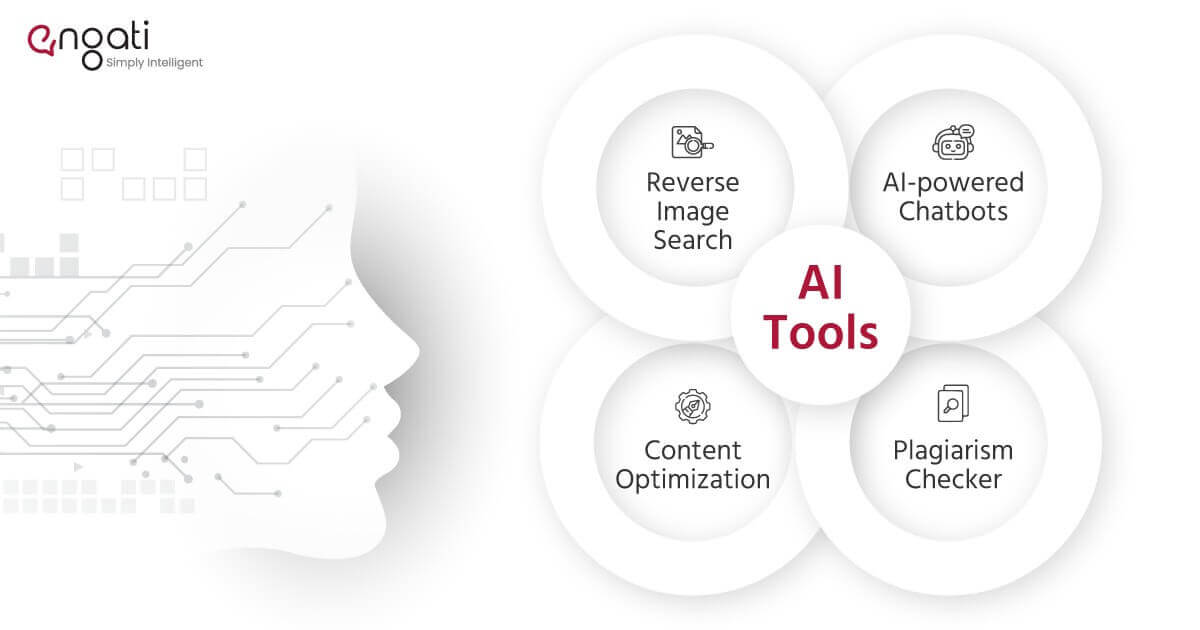
AI technology tools are imperative towards formulating and executing campaigns and tasks in this current digital world. Here are 4 tools at your disposal.
Computational statistics or statistical computing focuses on the bond between statistics and computer science to transform raw data into knowledge. You could consider it to be the interface between statistics and computer science. Computational statistics is a field of computational science that focuses on the mathematical science of statistics. The field of computational statistics is growing at a tremendous pace and there are a large number of advancements being made in it. This has led to the statistics community urging that a broader concept of computing needs to be included in the curriculum as a part of general statistical education.
The objective of the field of computational statistics is the same as the objective of traditional statistics: transforming raw data into knowledge and deriving valuable insights from it. The main difference, however, between computational statistics and traditional statistical techniques is that computational statistics concentrate on making use of computer-intensive statistical methods, especially in situations where there is an extremely large sample size and there also are non-homogenous datasets.
Even though the terms ‘computational statistics’ and ‘statistical computing’ tend to be used in an interchangeable manner most of the time, one of the former presidents of the International Association for Statistical Computing, Carlo Lauro, suggested that there is a difference between these two terms.
Carlo defined ‘statistical computing’ to be "the application of computer science to statistics” and defined ‘computational statistics’ to be "aiming at the design of an algorithm for implementing statistical methods on computers, including the ones unthinkable before the computer age (e.g. bootstrap, simulation), as well as to cope with analytically intractable problems"
The term ‘computational statistics’ could also refer to computationally intensive statistical techniques like Markov chain Monte Carlo methods, kernel density estimation, resampling methods, local regression, artificial neural networks, as well as generalized additive models.

Here are some peer-reviewed computational statistics journals that you should consider reading:
In addition to the journals mentioned above, here are two other journals that deal with computational statistics that you should read:
Here are some more statistical computing resources that you could refer to:
The most significant difference between computational statistics and machine learning is that computational statistics deals with and focuses on handling statistical problems and uses computing devices to solve those problems, while machine learning, on the other hand, deals with and focuses on the problem of simulating human learning on machines.
The main difference between computational statistics and data science is that computational statistics is a subarea of scientific computing that follows scientific rigor, but data science is a field in which data scientists tend to be satisfied with accepting any method that offers the best business value.
There are several ways in which the roles of statisticians and computer scientists converge and merge. Let’s take the development of models and data mining as an example. The traditional statistical approach to models would tend to involve random models with prior knowledge of the data. But, the computer science approach, on the contrary, would lean more towards algorithmic models without prior knowledge of the data. These approaches end up coming together in attempts to solve problems.
The computer science data mining processes have statistical counterparts. For example:
Computer scientists and statisticians tend to have complaints regarding each others’ disciplines. Here are some of these complaints.
R is a language and an environment that is used for statistical computing and graphics. It has similarities with the S language and environment developed at Bell Laboratories by John Chambers and colleagues. R is a GNU project that can be considered to be a different implementation of S. Even though there are some major differences between R and S, a lot of the code written for S runs unaltered under R.
R offers a vast range of statistical (linear and nonlinear modelling, classical statistical tests, time-series analysis, classification, clustering, etc.) and graphical techniques, and is rather highly extensible.
The R environment is an integrated suite of software facilities that can be used for data manipulation, calculation and graphical display. It includes:
Drive to Reimagine
AI technology tools are imperative towards formulating and executing campaigns and tasks in this current digital world. Here are 4 tools at your disposal.

Drive to Reimagine
We've evolved from using rules-based chatbots to exploring more sophisticated chatbots because of data, AI, and NLP. Explore the history and uses in this blog.
Conversational Automation
Global Chatbot Statistics for 2022 is here and is packed with many exciting updates. There’s a lot of info for businesses to take advantage of. Read more