Future of CX
16 customer service metrics that you absolutely need to track
If you want to improve your customer service, you need to measure the quality of your service. Here are 16 of the most important customer service metrics.
Modern companies must always strive to deliver high-quality customer experiences (CX) – however, research suggests that most are falling short.
As per a 2023 report by digital experience platform provider Acquia, 82% of marketers believe they meet their customer’s expectations, but only 10% of the customers surveyed agreed.
An important reason for this discord is the absence of a structured and consistent strategy or framework to power CX design and make decisions that influence the customer journey.
A customer experience framework provides organizations with a standardized CX design and delivery blueprint.
The customer experience framework is a blueprint that determines the tools, procedures, and techniques employed when engaging customers at different stages of the pre-and post-purchase journey across multiple channels.
A customer experience framework of CX framework is an essential part of a company’s overall CX strategy. There is no one definition of how the framework will take shape.
Every company must assess its organization and unique customer cohort needs before creating a blueprint that works for them. That is why companies often employ third-party consultants and analysts to evaluate their landscape and envision a CX framework suited to their current and future requirements.
No matter which framework you choose, or even if you develop your own, it must address the following six pillars:
The element of strategy in a CX framework defines the vantage point from which a company prioritizes its CX decisions. It could put the customer’s needs; first, it could prioritize business outcomes, pivot around a specific quarterly or annual target, focus on an organizational change like entry into a new region, etc.
This pillar determines the degree of involvement from the organisation's various stakeholders, from grassroots employees to decision-makers and senior leaders. It lays down each stakeholder’s role in executing the CX framework and converting its objectives into reality.
Many CX is digital; organizations must factor this into their CX framework. It is essential to ensure availability to customers through their chosen communication methods, including social media, online chat, and text messaging. Another component that contributes to a positive CX is mobile optimization.
Customer service is all about providing quick and practical answers. This ensures that the consumer will continue to do business with you. Additionally, customer service may be enhanced by soliciting feedback. Surveys are an excellent tool to get meaningful insights and feedback from consumers to make process changes. All of this must be part of the company’s CX framework.
This is an increasingly important element in CX frameworks, as it considers the intrinsic needs of a buyer, user, or client before designing the customer experience. Values refer to the intangible cultural expectations that determine customer decisions; whole behaviour is how these values manifest in the real world.
By stages, we mean the various mindset shifts and points of decision-making that a customer will traverse before and after a transaction. CX stages often take place across multiple channels, which is why this pillar must intersect with the technology component of a customer experience framework,
There are six steps a company can follow to arrive at an actionable CX framework, which can then be distributed across customer-facing teams like marketing, sales, customer success, and inbound support.
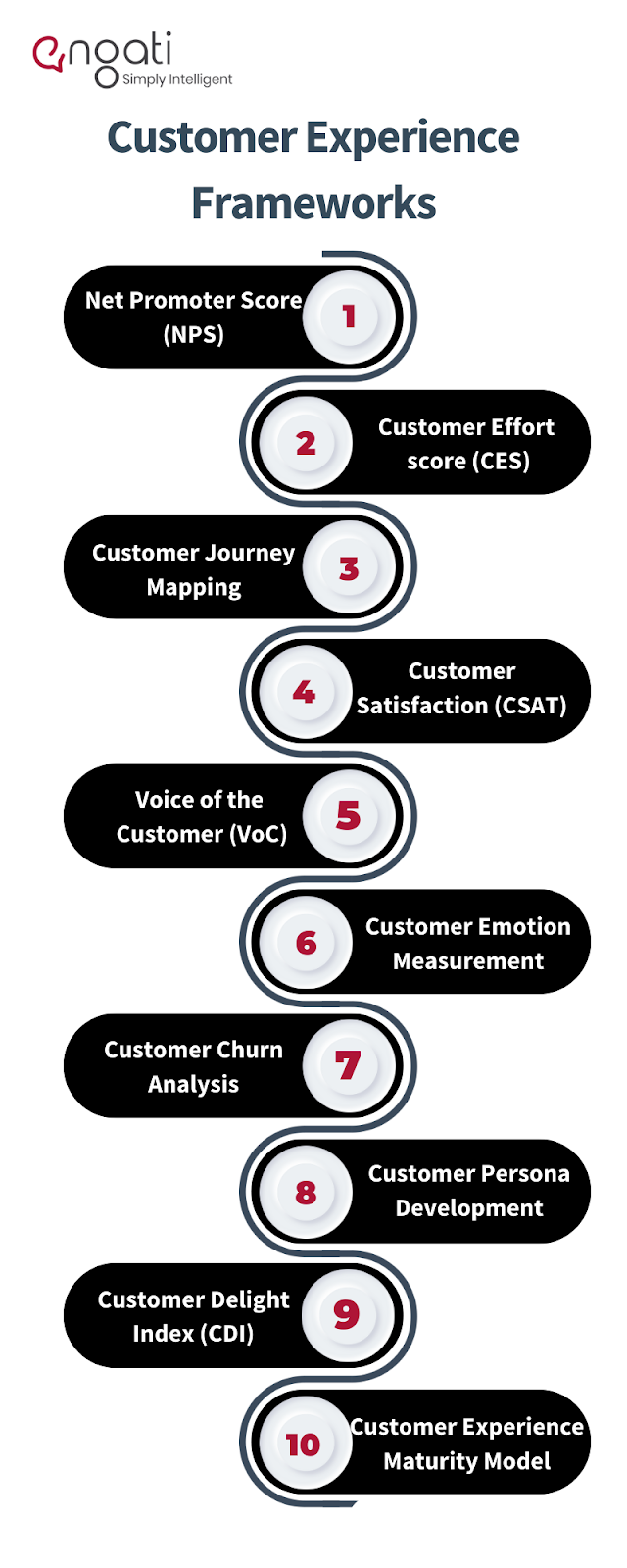
NPS is a widely recognized customer experience framework that measures customer loyalty and gauges customer satisfaction. It asks customers a single question: "On a scale of 0 to 10, how likely are you to recommend our product/service to a friend or colleague?" Based on their responses, customers are categorized as promoters, passives, or detractors, providing insights into overall customer sentiment.
Example: After making a purchase, a customer receives an email asking, "How likely are you to recommend our product to a friend or colleague?" The customer can respond with a score from 0 to 10. Based on the NPS calculation, the company can categorize customers as promoters (9-10), passives (7-8), or detractors (0-6). This helps identify loyal customers and potential brand advocates.
Application: Companies use NPS to measure overall customer loyalty and track changes over time. It helps identify areas of improvement and gauge the effectiveness of customer service initiatives.
CES focuses on the effort customers have to put in to accomplish their goals with the company. It measures how easy or difficult it is for customers to interact with the organization and addresses pain points in the customer journey.
Example: After resolving a customer service inquiry, the customer is asked to rate the level of effort required to find a solution on a scale from "very easy" to "very difficult."
Application: Organizations use CES to pinpoint pain points in the customer journey and reduce customer effort. Companies can enhance customer satisfaction and retention by addressing issues that cause frustration and complexity.
This framework involves creating visual representations of the entire customer journey, highlighting touchpoints, pain points, and opportunities for improvement. Customer journey maps help organizations better understand their customers' experiences.
Example: A retail company visually represents the end-to-end customer journey, starting from the initial product discovery to the post-purchase support. The map highlights critical touchpoints, emotions, and potential areas for improvement.
Application: Customer journey maps help organizations understand customer perspectives, identify pain points, and design targeted improvements to deliver a seamless and satisfying customer experience.
CSAT is a straightforward customer experience framework that assesses customers' satisfaction with specific interactions, products, or services. Customers are asked to rate their satisfaction on a scale, usually from 1 to 5 or 1 to 10.
Example: A hotel chain sends post-stay surveys to guests, asking them to rate their satisfaction with their recent stay experience on a scale from 1 to 5.
Application: CSAT surveys help organizations measure customer satisfaction after specific interactions or transactions. Companies can use CSAT scores to identify issues, reward outstanding service, and improve overall customer experience.
VoC is a systematic approach to capturing customer feedback and preferences. It includes methods such as surveys, focus groups, interviews, and social media monitoring to gain insights into customer expectations and sentiments.
Example: An e-commerce company collects feedback through online surveys, social media listening, and customer service interactions to gain insights into customer preferences, expectations, and pain points.
Application: VoC programs help organizations collect and analyze customer feedback to understand customer needs better and align their products and services.
This framework aims to measure customers' emotional responses to interactions with the company. Understanding emotions allows organizations to create more emotionally resonant experiences that drive customer loyalty.
Example: A software company uses sentiment analysis on customer support interactions to gauge customer emotions, such as frustration or satisfaction.
Application: By understanding customer emotions, companies can tailor experiences to evoke positive emotions, build stronger emotional connections with customers, and foster brand loyalty.
Churn analysis is a CX framework identifying why customers leave or stop using a product or service. By understanding the causes of churn, organizations can implement strategies to improve customer retention.
Example: A subscription-based streaming service analyzes customer churn data to identify patterns and reasons behind customer cancellations.
Application: Churn analysis helps organizations predict and reduce customer churn by addressing the root causes of attrition and implementing proactive retention strategies.
Creating customer personas involves developing fictional characters that represent different segments of the target audience. These personas help organizations understand customers' needs, preferences, and pain points, enabling them to design personalized experiences.
Example: An automobile manufacturer creates customer personas like "Eco-conscious Commuter" or "Adventure Seeker" based on market research and customer insights.
Application: Customer personas help organizations understand their target audience's needs, motivations, and preferences, enabling personalized marketing and tailored experiences.
CDI measures the degree of delight customers experience while interacting with the company. It identifies areas where organizations can go above and beyond customer expectations.
Example: A luxury hotel chain surprises guests with personalized welcome amenities and anticipates their preferences during their stay.
Application: CDI measures the level of customer delight and helps organizations create memorable and unique experiences that exceed customer expectations.
This framework assesses an organization's CX capabilities and maturity level across different dimensions. It helps organizations identify their current CX strengths and weaknesses and set priorities for improvement.
Example: A retail company uses a CX maturity model to assess its capabilities across various dimensions like customer-centric culture, technology adoption, and data-driven decision-making.
Application: The maturity model helps organizations identify their CX strengths and weaknesses, set improvement priorities, and evolve towards a more customer-centric approach.
Amazon is a prime example of a company that prioritizes customer experience. Their CX framework is built around personalization, convenience, and customer-centricity. They use advanced data analytics and machine learning algorithms to offer personalized product recommendations, one-click ordering, and fast delivery options. The result is a seamless and effortless shopping experience for customers, leading to high levels of customer satisfaction and loyalty.
Zappos, an online shoe and clothing retailer, is renowned for its exceptional customer service. Their CX framework revolves around creating a culture of delivering WOW through service. Zappos empowers its customer service representatives to go above and beyond to exceed customer expectations. They offer free and easy returns, 24/7 customer support, and a strong emphasis on building genuine connections with customers. This customer-centric approach has helped Zappos build a loyal customer base and achieve high customer retention rates.
Airbnb, the popular online vacation rental platform, has a customer experience framework that focuses on trust and community-building. Their CX strategy centers around ensuring safety, authenticity, and transparency in their listings. They leverage user reviews and ratings to build trust among users and provide a platform for open communication between hosts and guests. This approach has resulted in a strong sense of community and trust among users, leading to continued growth and success for the platform.
Starbucks has a well-established CX framework that centers on creating a welcoming and personalized in-store experience. They train their baristas to greet customers warmly, remember their names and preferences, and provide high-quality beverages consistently. Starbucks also emphasizes creating a comfortable and inviting ambiance in their stores. This focus on delivering a positive and personalized experience has helped Starbucks become one of the most recognized and beloved coffee brands globally.
Ritz-Carlton is renowned for its luxurious and top-notch customer experience. Their CX framework is based on providing anticipatory and personalized service to each guest. Every employee at Ritz-Carlton is empowered to resolve issues on the spot, and they are trained to anticipate guest needs. This attention to detail and personalized approach has earned Ritz-Carlton a reputation for excellence in customer service and has led to high customer loyalty and repeat business.
.

Future of CX
If you want to improve your customer service, you need to measure the quality of your service. Here are 16 of the most important customer service metrics.

Future of CX
Customer Satisfaction Score, or CSAT, is a metric used by companies and marketers to navigate through a customer’s feelings through the customer lifecycle.
Future of CX
Understand how to segment your customer base and deliver impactful, tailored experiences to every one of your customer segments. Learn all about it right here!