Drive to Reimagine
How chatbots have evolved with data and AI
We've evolved from using rules-based chatbots to exploring more sophisticated chatbots because of data, AI, and NLP. Explore the history and uses in this blog.
Data collection is the process of gathering data and measuring it on variables of interest, in a systematic manner that makes it possible for you or your organization to answer stated research questions, test hypotheses, evaluate outcomes, and make predictions about future probabilities and trends.
It focuses on finding out all there is to know about a specific subject.
When hypothesis testing is conducted on the data that you collect, assumptions are eliminated and propositions that are based on reason are made.
In different areas of study, different approaches to data collection are used. The approach used depends on the information that is required.
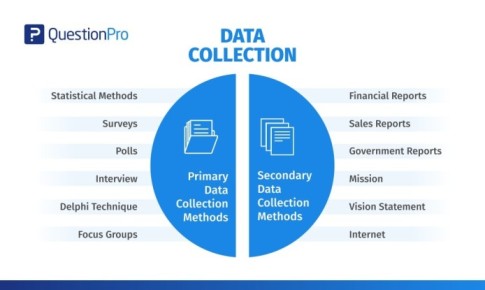
The key purpose of data collection is to ensure that information-rich and reliable data is gathered for statistical analysis so that data-driven decisions can be made for research.
The collection of data should make it possible for you to put the researcher in a vantage position, enabling them to make better predictions about future probabilities and trends.
Data collection enables you to capture a record of past events so that you can use data analysis to detect recurring patterns. Those patterns can then be used to build predictive models by making use of machine learning algorithms that look for trends and predict future changes.
Since predictive models are only as good as the data on which they are built, you need to have good collection practices in order to develop high-performing predictive models. The data need to be free of errors and should contain information that is relevant to the task at hand.
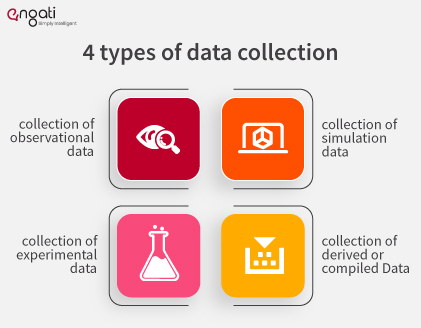
The 4 types of data collection are:
You can capture observational data by the method of observing a behavior or activity. It is collected by making use of techniques like human observation, open-ended surveys, or even by using an instrument or sensor for monitoring and recording information.
Since observational data is captured in real-time, if the data gets lost, it would be incredibly difficult (or even impossible) to recreate it. You will need extra backup procedures to reduce the risk of losing the data.
You can collect experimental data by actively intervening to generate and measure change or to create differences when a variable is altered. Experimental data usually allows researchers to determine causal relationships and they are generally projectable to larger populations. In most cases, it is possible but expensive to reproduce experimental data.
You can gather simulation data by mimicking the operation of a real-world process or system over time by using computer test models. Simulation data is collected to determine what would or could happen under specific conditions.
The test model used is usually as important as, and sometimes even more important than, the data generated from the simulation.
Deriving or compiling data involves making use of existing data points, usually from several data sources, to create new data through a transformation like an arithmetic formula or aggregation. This type of data can be replaced if it is lost, but replacing it tends to be a very time-consuming and expensive task.
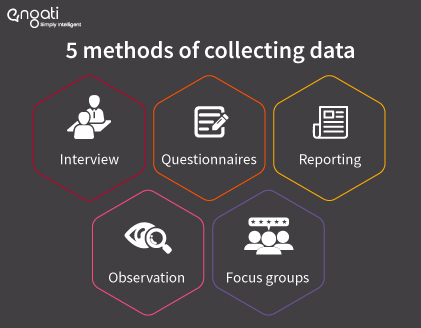
The methods used for data collection depend on the information that is needed. Here are the most common methods of data collection:
Essentially a conversation between two individuals with the aim of collecting relevant information to satisfy a research purpose. The types of interviews are:
This involves collecting data by using an instrument that consists of a series of questions and prompts to receive responses from individuals to whom it is administered. They are designed to collect data from groups.
Questionnaires are not surveys, they form a part of a survey. The questions asked in a questionnaire can be of three types:
The major advantage of questionnaires is that they can be easily administered in large numbers and are cost-effective. It is possible to use them to compare and contrast previous research to measure change. They’re also rather inexpensive and are easy to visualize and analyze.
Data reporting refers to gathering and submitting data to be further subjected to analysis. Reporting accurate data is critical because of inaccurate data reporting causes uninformed (or worse, misinformed) decision-making.
When the data reported is accurate, it leads to informed decision making and the data is easily accessible. The issues that are faced in this method of data collection is that self-reported answers might be exaggerated and the results might be affected by bias.
Here, the data regarding a phenomenon is gathered through observation. The nature of the observation could be gathered either as a complete observer, as a complete participant, or as a participant-observer. The benefits are that it is easy to administer and there can be a greater accuracy in the results. However, there may be bias involved and its validity cannot be predicted accurately.
Focus groups are used for the collection of qualitative data. It involves asking a group of individuals open-ended questions for them to provide answers and feedback.
The problems with this method are that the information might not be as detailed and there might still be bias evident. There’s also the issue that it is hard to assemble a completely diverse and inclusive group and a few voices might steer the conversation. Some participants might not even reveal their actual thoughts, instead, they would say what the others are saying so that they can fit in with the group.
In addition to these, there are many other data collection methods available which you can employ depending on the situation and on the kind of data that you want to collect.
Drive to Reimagine
We've evolved from using rules-based chatbots to exploring more sophisticated chatbots because of data, AI, and NLP. Explore the history and uses in this blog.
Tech Corner
Data is currently scattered in most enterprises. Data scientists & developers are working on a common framework. Read on to learn how chatbots are helping!
Drive to Reimagine
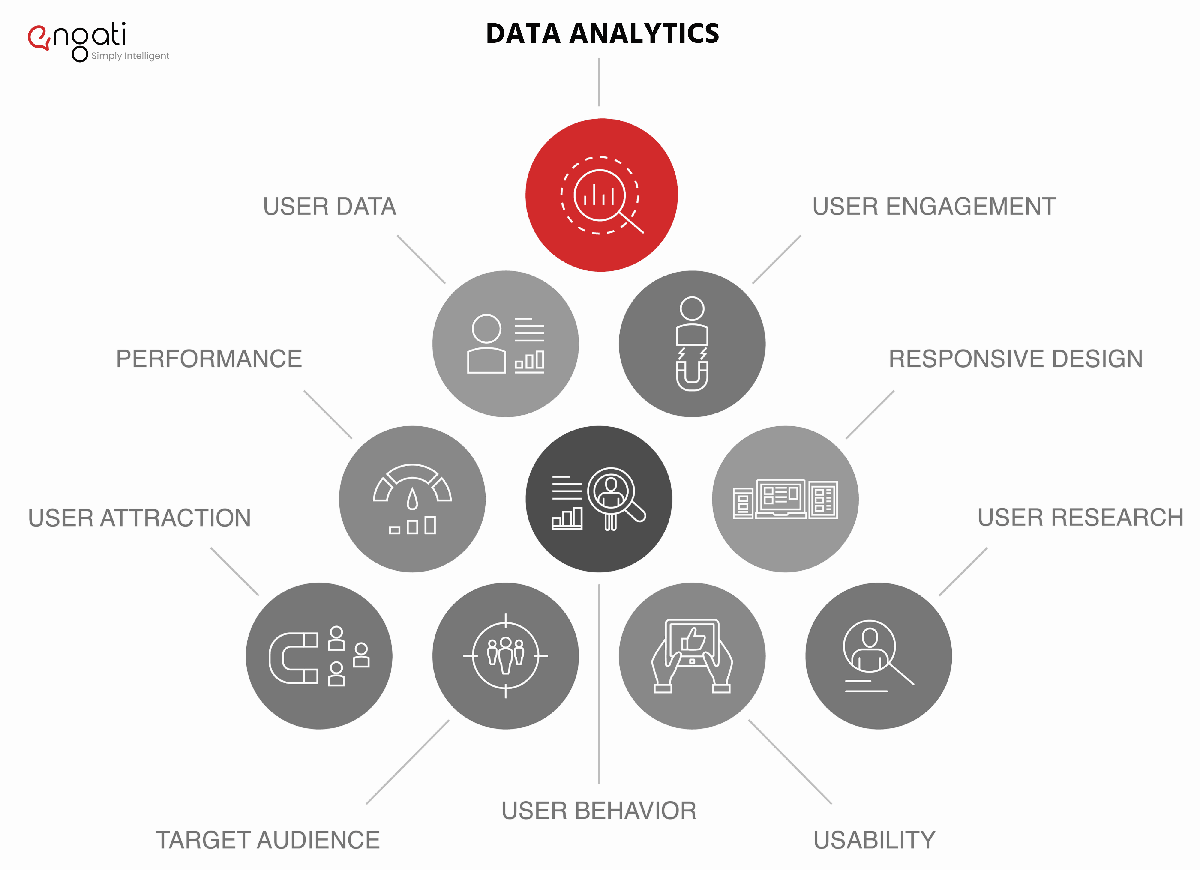
Data analytics, when used correctly, can enable product designers to see things with clarity. Here’s how to implement a data-driven approach to product design.