Drive to Reimagine
7 ways to promote your eCommerce store in 2023
An eCommerce platform needs to be mobile-friendly if you want to attract more customers, retain them and gain customer loyalty. Check out the article now!
An eCommerce funnel or an eCommerce conversion funnel is a way of understanding your customer journey on your eCommerce portal. It flows from awareness to conversion and beyond to loyalty and advocacy.
It includes the path that you design for your visitors as they reach your portal and flow through it, eventually reaching the checkout stage.
If you don’t have clear funnels and put everything in place to guide your users through the funnel, it can be rather chaotic and confusing for your visitors and prospective customers.
You won’t be able to guide them to conversion, loyalty, and advocacy; leaving them to wander aimlessly through your eCommerce portal.
But that’s not all.
If you don’t have a properly mapped out and well-defined eCommerce funnel, you won’t know where you are lacking and which steps of the funnel need to be improved and optimized.
A clear eCommerce funnel creates a better customer experience for your customers and even increases your chances of converting them into loyal customers and later into brand evangelists.
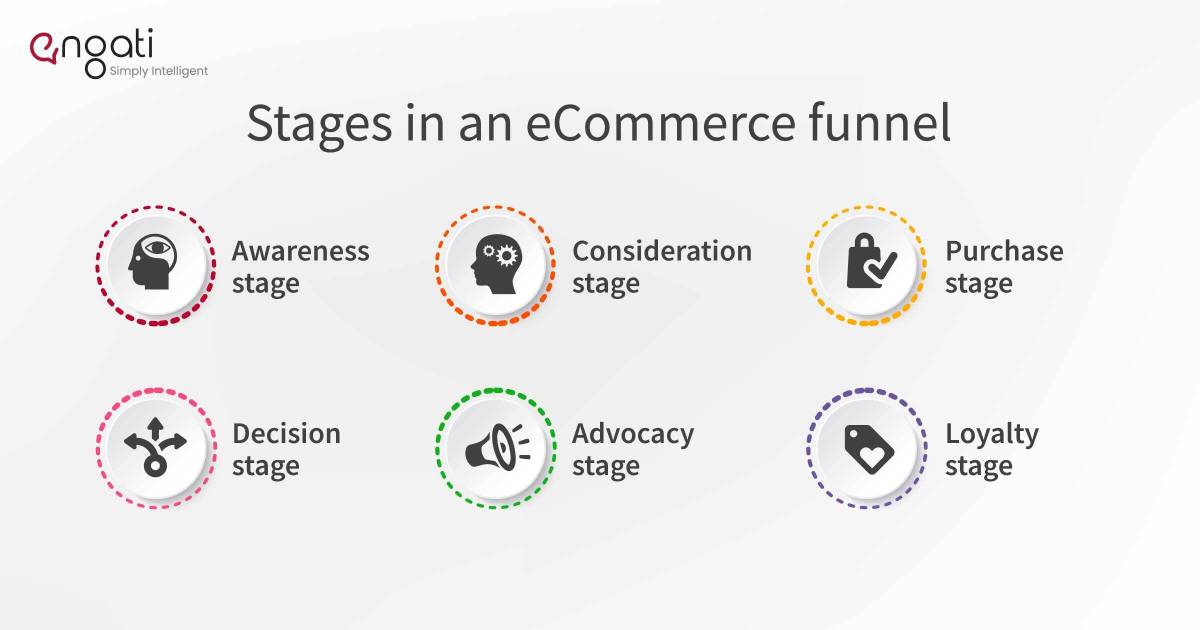
There are various ways to break down an eCommerce conversion funnel. Some organizations opt for a three-stage funnel, some prefer a four-stage funnel, some even choose funnels that have five or six stages in them.
We will look at a six-stage funnel here:
This is where your prospects just find out about your store. They learned about you through social media posts, organic search, paid ads, and a range of other TOFU (top-of-funnel) marketing tactics.
You’ve got their attention now. They have displayed interest. Now you need to keep them hooked and build their trust in you.
Use social proof in the form of reviews, testimonials, etc. You should also display trust symbols and badges to make them feel secure.
Here’s where they’re debating with themselves, trying to figure out whether to go ahead and make a purchase. It’s time to incentivize them and create urgency. Use limited-time offers like discounts and free shipping. Add a countdown timer to increase the level of urgency.
Your customers have now reached the bottom of the funnel. You’ve made great efforts to get them there and you certainly don’t want to waste those efforts by having your prospects drop out there.
Create a smooth, frictionless checkout process.
These customers have taken the leap and made their first purchase. Now you need to keep them coming back for more.
Look for cross-selling and upselling opportunities. You may even want to consider creating a loyalty program.
Another great way to increase loyalty is to incentivize your customers to create accounts. But don’t make that compulsory, or else you’ll be facing higher levels of cart abandonment.
This is where your customers start telling the people in their circles about you. The most effective way for you to make that happen is to create a fantastic customer experience.
The next thing you could do is start a referral program. However, creating a powerful customer experience will always be more effective.
Here are the main steps involved in optimizing your eCommerce conversion funnel:
A Shopify funnel is essentially a marketing or sales funnel that illustrates the steps that your customers go through before they make a purchase from your Shopify store. But just like other eCommerce funnels in general, it goes beyond the actual purchase towards loyalty and advocacy.
It could pretty much be considered to be a visualization of the customer journey on your Shopify store. It’s got the same stages as a generic eCommerce funnel:
During this stage, you want to attract people to your store. But not just anybody, you want to attract the right ones. To gain the attention of people who are likely to become your customers, you can run Facebook ads, work on SEO, run Google Ads (and make sure they match the messaging on your store), and even create powerful content (especially content that educates your potential customers).
This is where your store’s visitors compare your offerings with those of your competitors. They’ll go through product features, look at your pricing and even your shipping and return policies. To help them during the consideration stage, you should write detailed, convincing product descriptions, use great images (especially with a human using the product), and display positive product reviews from your customers.
This is where they actually make the decision to buy from you. You should guide them towards this decision by creating clear CTAs and even playing on the principle of scarcity.
They’ve made the decision and have begun the checkout process. To help them flow through the purchase stage, you need to have a simplified, seamless checkout process with minimal friction. Your Shopify website’s design should also be intuitive.
Your customers reach these stages when your product works well for them and you create a great customer experience. It’s all about treating your customers right and making them feel good about you and your Shopify store.

Drive to Reimagine
An eCommerce platform needs to be mobile-friendly if you want to attract more customers, retain them and gain customer loyalty. Check out the article now!
Drive to Reimagine
The hardest part of eCommerce business is all about acquiring new leads, here are the 7 interesting way to generate leads for your eCommerce business
Drive to Reimagine
Differentiate your business by winning at eCommerce customer service. Understand all the benefits, techniques, and best practices here for better results!