Tech Corner
How to use Docker for Automation Testing?
Docker is a Platform as a Service that provides OS-level virtualization. Docker makes it easy to create, deploy, and run applications using containers.
Hyper-automation is the use of advanced technologies, like artificial intelligence (AI), machine learning (ML), and robotic process automation (RPA), to automate common tasks. However, it refers to the tasks and processes that can be automated and the level of automation. It is often referred to as the next major phase of digital transformation.
It is important to note that hyper-automation is not meant to entirely replace humans. Rather, through automation, humans are freed from repetitive and low-value tasks to focus on higher value to the organization. Together, automation and human involvement help organizations to provide superior customer experiences while reducing operational costs and boosting profitability.
The ability to include humans in the digitization process is a key component of hyper-automation. The first wave of automation technologies largely relied on robotic process automation (RPA). RPA involves the use of bots to mimic repetitive human tasks. These processes are rule-based and utilize structured data to complete actions. Unlike artificial intelligence which seeks to simulate the human intellect, RPA focuses solely on human actions. With hyper-automation, digital workers operate alongside humans to deliver unmatched efficiency.
By using a combination of automation technologies, hyper-automation can overcome some of the limitations of approaches that rely on a single automation tool. This allows organizations to move beyond the confines of individual processes and automate nearly any tedious and scalable task. Automation, however, requires careful planning and implementation. Organizations need to understand how digital technologies will fit into their existing workflow and what roles they will play in new processes. Simply introducing automation into a business process without appreciating the role that it will play, or automating a process that is already broken, can have major consequences at the organizational level.
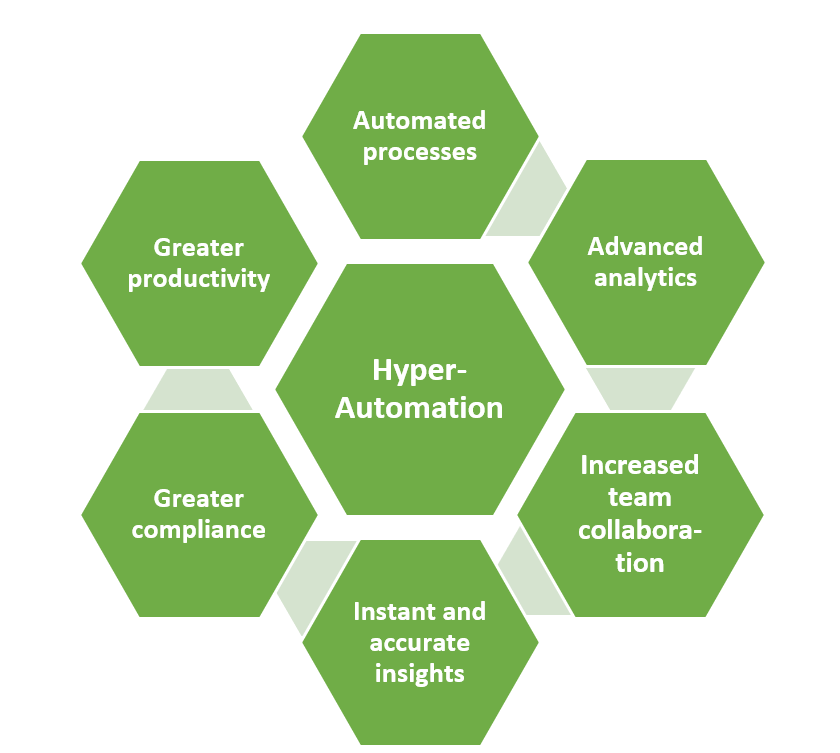
There are several automation technologies that comprise hyper-automation. These include
Emerging technology, such as automation, often brings fear of change. However, the coronavirus global pandemic has left many organizations facing unprecedented challenges in generating revenue and operating their core business. An increased workload during lockdown measures is proving difficult to manage for many. The uncertainty of predicting when and how the next business interruption will come means future-proofing the organization, investing to survive and prosper, and adapting traditional approaches to business and operations. This means embracing hyper-automation.
It brings flexiblitiy and scalibility into a business’s operations and even manages to increase employee productivity by automating time-consuming tasks, enabling employees to focus on activities that add more value to the organization.
Hyperautomation even enables businesses to integrate a range of digital technologies across their business processes and their legacy systems. This allows data to flow in a better manner to all the stakeholders in an organization.
By making use of powerful analytical tools and hyperautomation, businesses can optimize the way they deploy their resources, thus reducing costs while increasing their revenue.
Using an Intelligent Automation platform, armed with advancements in artificial intelligence technologies, pushes the boundaries by connecting people, processes, and technologies to deliver Hyper-automation, which makes interactions between people and digital workers possible and seamless. This means you can control your outcomes, empower your people and accelerate your automation.
This application of technological advancements in process automation, including:
These technologies ensure dramatic results that mitigate compliance and risk while increasing efficiencies, profitability, and growth while combining historic legacy platforms with more recent and planned digital investments.
Hyper-automation is relevant in many industries, from banking and insurance to health and life science. There are virtually no limits to where hyper-automation can be leveraged. It’s more a matter of where the most significant return on implementing hyper-automation can be found.
For this reason, it’s more relevant to look at specific use cases for hyper-automation, as well as which underlying technologies it utilizes to deliver its value.
Generic examples or use cases for hyper-automation include:
The term ‘Hyperautomation’ was coined in Gartner’s Strategic Technology Trends for 2020. It focuses on applying advanced technologies like artificial intelligence (AI) and machine learning (ML) to increasingly automate processes and augment humans. It basically aims to add another layer of advanced technology on top of automation, which enables humans to do more with that technology.
While automation is more about RPA and task-oriented automation carried out by automation tools, hyperautomation is about sophisticated AI-based process automation carried out by multiple machine learning, packaged software and automation tools.
Automation is conducted from one platform and leads to efficient operations, while hyperautomation is conducted from an ecosystem of platforms, systems and technologies and leads to smart and efficient operations.
Hyperautomation essentially across inter-functional boundaries and employs a layer of artificial intelligence to come up with the best strategy for performing tasks.
Tech Corner
Docker is a Platform as a Service that provides OS-level virtualization. Docker makes it easy to create, deploy, and run applications using containers.

Drive to Reimagine
Recruitment Chatbots handle routine recruitment functions, allowing you to focus on higher-level tasks. Here's how they can scale up your recruitment processes
Future of CX
Revolutionize customer support with automation! Our article shows top tools & strategies to save costs & time. Discover how to automate customer support & make