Drive to Reimagine
How chatbots have evolved with data and AI
We've evolved from using rules-based chatbots to exploring more sophisticated chatbots because of data, AI, and NLP. Explore the history and uses in this blog.
Information extraction (IE) is the task of automatically extracting structured information from unstructured and/or semi-structured machine-readable documents and other electronically represented sources. In most cases, this activity concerns processing human language texts by means of natural language processing (NLP). Recent activities in multimedia document processing like automatic annotation and content extraction out of images/audio/video/documents could be seen as information extraction.
Gathering detailed structured data from texts, information extraction enables:
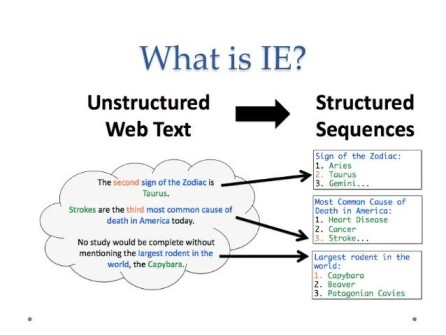
The process of informationa extraction is used for the purpose of extracting useful information from unstructured or semi-structured data. With big data, there are new issues for information extraction techniques to deal with, especially due to the growth of multifaceted data, also known as multidimensional unstructured data. Traditional information extraction systems are not powerful to deal with this enormous flood of unstructured big data. The sheer volume and variety of big data necessitates the improvement of the computational capabilities of these IE systems.
There have been several studies conducted on information extraction to address the challenges and issues faced with various data types like text, image, audio and video because of how important it is to understand the competency and limitations of the existing IE techniques related to data pre-processing, data extraction and transformation, and representations for vast quantities of multidimensional unstructured data.
There has been rather limited consolidated research work carried out to investigate the task-dependent and task-independent limitations of information extraction covering all data types in a single study.
However, the volume, variety (structured, unstructured, and semi-structured data) and velocity of big data has dramatically changed the paradigm of computational capabilities of information extraction technology.
IBM predicted that more than 2.5 quintillion bytes of data are generated every day. Predictions were also made that unstructured data from diverse sources will grow up to 90% in few years.
Due to the vast amounts of and the complexity of unstructured data, it would be next to impossible to manually extract relevant information from all the data available to you. It is important to understand the relationship between entities, make sense of the manner in which the events have unfolded, and find hidden gems of information.
Having an automated way to extract information from various forms of data, especially unstructured data, and then presenting that information in a structured manner brings several benefits and advantages to the table and even reduce the time spent on extracting the information substantially. Information extraction systems can perform this task at a significantly faster pace that humans can. It also allows you to focus on tasks that actually require your attention and effort while the system can take care of this mechanical task.
Information extraction enables you to retrieve pre-defined information like the name of a person, location of an organization, or even identify a relation between entities, and save this information in a structured format like a database.
Given the capricious nature of text data that changes depending on the author or the context, Information Extraction seems like a daunting task. But it doesn’t have to be that way!
We all know that sentences are made up of words belonging to different Parts of Speech (POS). There are eight different POS in the English language: noun, pronoun, verb, adjective, adverb, preposition, conjunction, and intersection.
The POS determines how a specific word functions in meaning in a given sentence. For example, take the word “right.” In the sentence, “The boy was awarded chocolate for giving the right answer,” “right” is used as an adjective. Whereas, in the sentence, “You have the right to say whatever you want,” “right” is treated as a noun.
This goes to show that the POS tag of a word carries a lot of significance when it comes to understanding the meaning of a sentence. And we can leverage it to extract meaningful information from our text.
Typically, for structured information to be extracted from unstructured texts, the following main subtasks are involved:
Information extraction can be entirely automated or performed with the help of human input.
Typically, the best information extraction solutions are a combination of automated methods and human processing.
Information extraction can be applied to a wide range of textual sources: from emails and Web pages to reports, presentations, legal documents and scientific papers. The technology successfully solves challenges related to content management and knowledge discovery in the areas of:
Drive to Reimagine
We've evolved from using rules-based chatbots to exploring more sophisticated chatbots because of data, AI, and NLP. Explore the history and uses in this blog.

Tech Corner
Data is currently scattered in most enterprises. Data scientists & developers are working on a common framework. Read on to learn how chatbots are helping!
Drive to Reimagine
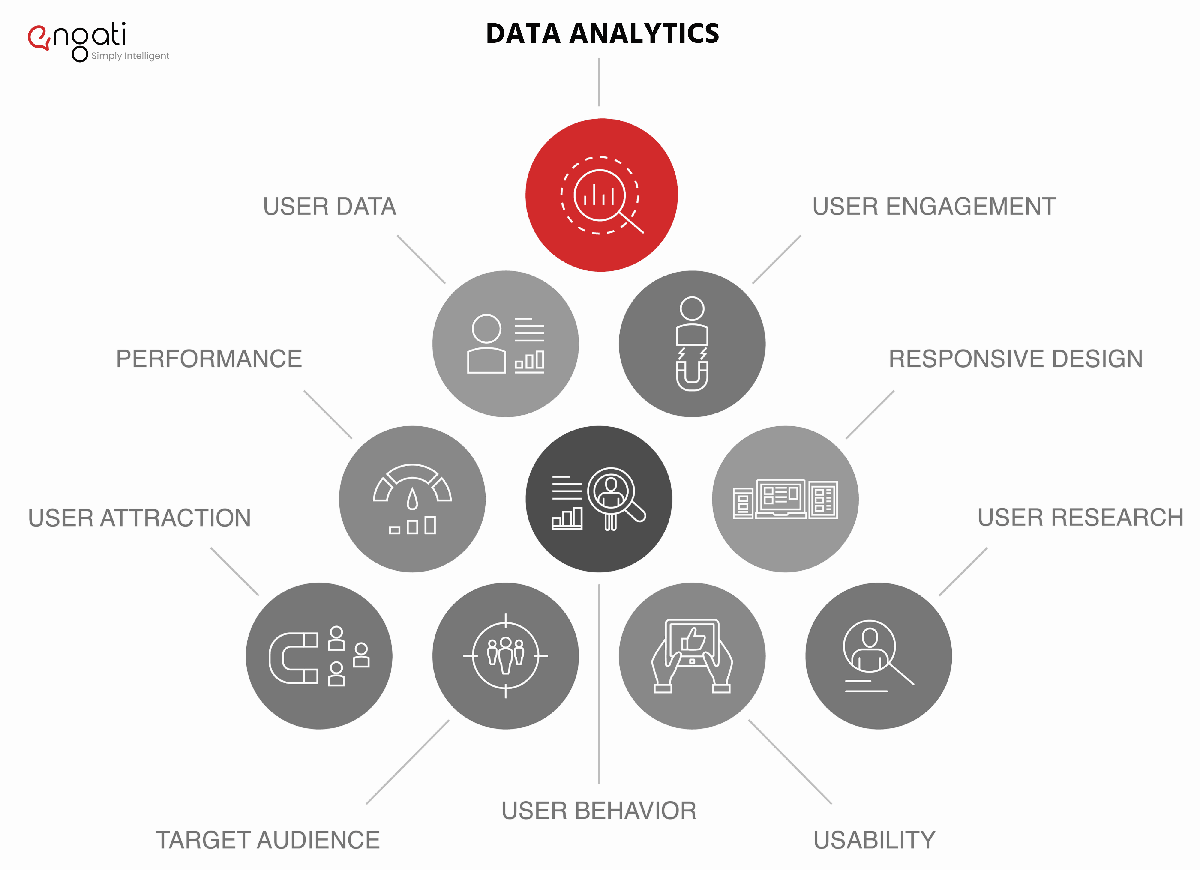
Data analytics, when used correctly, can enable product designers to see things with clarity. Here’s how to implement a data-driven approach to product design.