Drive to Reimagine
10 hacks to step up your logistics company's customer experience
Just delivering orders on time isn't good enough anymore. Your logistics company needs to deliver amazing customer experiences too. Here are 10 hacks for you!
The just-in-time (JIT) inventory concept is a manufacturing workflow and inventory management technique that seeks to reduce costs and flow times within production systems and the distribution of materials and products.
In just-in-time inventory management, goods and materials are received from suppliers only as they are needed. The whole point of this is to lower the company’s inventory holding costs and boost inventory turnover.
To implement JIT, you need to meticulously plan the whole supply chain and make use of the right software in order to carry out the entire process till delivery. Doing that will increase efficiency and reduce the scope for error substantially because every process will be very carefully monitored.
Along with reducing your inventory carrying costs, using the just-in-time strategy also helps you reduce your inventory waste by reducing the chances of overproduction, not allowing the supply to exceed the demand for the products, thus avoiding the accumulation of unsellable inventory.
You’d want to source your supplies locally as far as possible under this system so that your lead time is reduced and the supplies are delivered to you much faster.
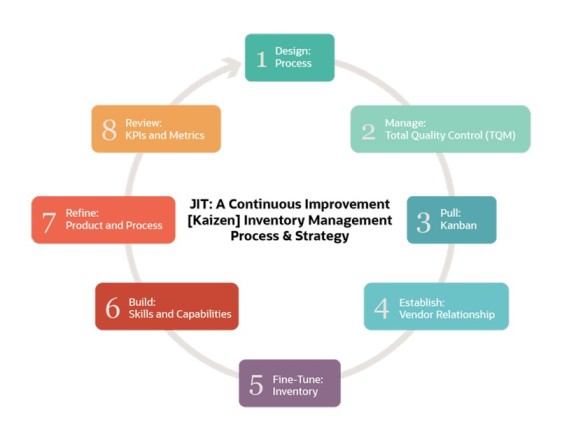
The main objective and purpose of the just-in-time inventory system is to reducing your carrying and warehousing costs for your inventory and to increase your inventory turnover.
Warehousing can be rather costly, and the more inventory you hold, the higher your costs become. The just-in-time inventory system helps you reduce these costs because you only place an order with your suppliers when you actually need it. Under this inventory system, you could place an order with your supplier only after your customer orders from you. This means that the item that you order is sold even before it reaches you, so you won’t have to store it too long. Following this inventory management system could help you reduce the number of items that you have to store in your warehouse, or get rid of the need for warehouses completely.
It also gives manufacturers more control and flexibility. They produce on a demand-pull basis, so if certain items have a greater level of demand, the manufacturer can quickly scale up production for those items by ordering more raw materials for it and scale down the production of other items that do not receive enough demand.
Since only essential items are ordered, there is less working capital required in the procurement process. Since there is a smaller amount of stock held in the inventory, the company’s return on investment would be high. The Just-in-time model employs the “right first time” concept which seeks to perform the activities correctly the very first time they are carried out, thus lowering inspection and rework costs. This reduces the amount of investment required by the company, minimizes the need to spend money to rectify errors, and increases the profit earned from selling the product.
The just-in-time inventory system is used by large enterprises as well as small businesses due to the fact that it increases cash flow and reduces the amount of capital needed to run the business. The Toyota Motor Corporation, of course, is a large enterprise that has always been the biggest proponent of the just in time inventory system.
The JIT inventory management system is widely used by retailers, technology manufacturers, automobile manufacturing companies, on-demand publishers, restaurants, and other types of companies across a wide range of industries.
Major retailers like Target and Walmart also use this system in a way, seeing how they order their seasonal merchandise and make sure that it arrives right when demand is starting to pick up for certain items.
Here are some of the characteristics of a just-in-time inventory system:
The main advantages of JIT are:
The main disadvantages of JIT are:
Drive to Reimagine
Just delivering orders on time isn't good enough anymore. Your logistics company needs to deliver amazing customer experiences too. Here are 10 hacks for you!

Drive to Reimagine
An eCommerce platform needs to be mobile-friendly if you want to attract more customers, retain them and gain customer loyalty. Check out the article now!

Drive to Reimagine
The art of selling is seeing an evolution in motion. From door-to-door to conversational selling. Here are 4 E-commerce companies crushing it with this method.