Tech Corner
Contrastive Learning in NLP
Contrastive learning is used to train a model to learn representations of images or sentences using vectors. We'll explore how it works in this article.
What is the Kernel method?
The kernel method is the mathematical technique that is used in machine learning for analyzing data. This method uses the Kernel function - that maps data from one space to another space.
It is generally used in Support Vector Machines (SVMs) where the algorithms classify data by finding the hyperplane that separates the data points of different classes.
The most important benefit of the Kernel Method is that it can work with non-linearly separable data, and it works with multiple Kernel functions - depending on the type of data.
Because the linear classifier can solve a very limited class of problems, the kernel trick is employed to empower the linear classifier, enabling the SVM to solve a larger class of problems.
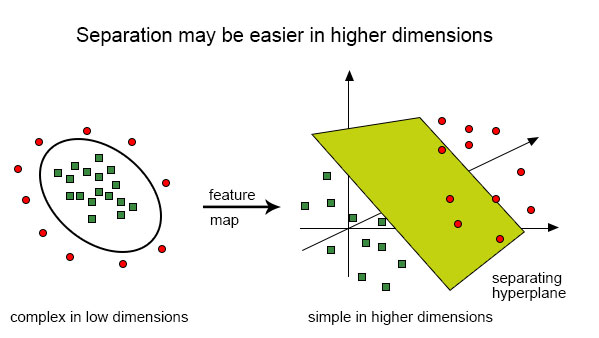
Source: eduCBA
Support vector machines use various kinds of kernel methods in machine learning. Here are a few of them:
It is used when the data is linearly separable.
K(x1, x2) = x1 . x2
It is used when the data is not linearly separable.
K(x1, x2) = (x1 . x2 + 1)d
The Gaussian kernel is an example of a radial basis function kernel. It can be represented with this equation:
k(xi, xj) = exp(-𝛾||xi - xj||2)
Similar to the RBF kernel, but it decays much more quickly.
k(x, y) =exp(-||x -y||22)
Similar to RBF Kernel, it has a sharper peak and faster decay.
k(x, y) = exp(- ||x - y||)
It is used for non-linear classification problems. It transforms the input data into a higher-dimensional space using the Sigmoid kernel.
k(x, y) = tanh(xTy + c)
It is a multiple-input kernel function that can be used for feature selection.
k(x, y) = k=1nexp(-(xk -yk)2)d
It maps the input data to an infinite-dimensional space.
K(x, y) = exp(-γ ||x - y||^2)
It is a non-stationary kernel function that can be used for time-series analysis.
K(x, y) = ∑φ(i,j) Ψ(x(i),y(j))
This function is based on eigenvalues & eigenvectors of a similarity matrix.
K(x, y) = ∑λi φi(x) φi(y)
This function takes into account the covariance structure of the data.
K(x, y) = exp(-1/2 (x - y)T S^-1 (x - y))
The kernel method in SVM works in the following way:
1. Data Preprocessing - Cleaning the data & normalizing it to get the features at the same level.
2. Kernel Function Selection - Select the correct kernel function that maps the data into a higher-dimensional space.
3. Kernel Matrix Computation - Compute the kernel matrix that measures the similarity between the data pointers in the input space.
4. Feature Space Mapping - The kernel matrix is then used to map that input data into the higher-dimensional space.
5. Model Training - The final step is to train the model on the mapped data.
SVMs are a popular type of machine learning algorithms that are used with kernel methods for solving classification & regression problems.
You can break the SVM strategy down into two steps:
1. The data is projected implicitly onto a high-dimensional space through the kernel trick.
2. Apply a linear classifier to the projected data.
The choice of kernel in SVM depends on the type of data being analyzed & the problem being solved. Here's how you can go about choosing the right kernel function:
1. Understand the problem - Understand the type of data, features, and the complexity of the relationship between the features
2. Choose a simple kernel function - Start with the linear kernel function as it serves as the baseline for comparison with the complex kernel functions.
3. Test different kernel functions - Test polynomial, RBF kernel, etc and compare their performance.
4. Tune the parameters - Experiment with different parameter values & choose the values that deliver the best performance.
5. Use domain knowledge - Based on the type of data, use the domain knowledge & choose the right type of kernel for your data set.
6. Consider computational complexity - Calculate the computation type & the resources that would be required for larger data sets.
Tech Corner
Contrastive learning is used to train a model to learn representations of images or sentences using vectors. We'll explore how it works in this article.
Tech Corner
LASER approach is based on zero-shot transfer (deep learning networks) of NLP models from one language to other languages where training data is limited.
Tech Corner
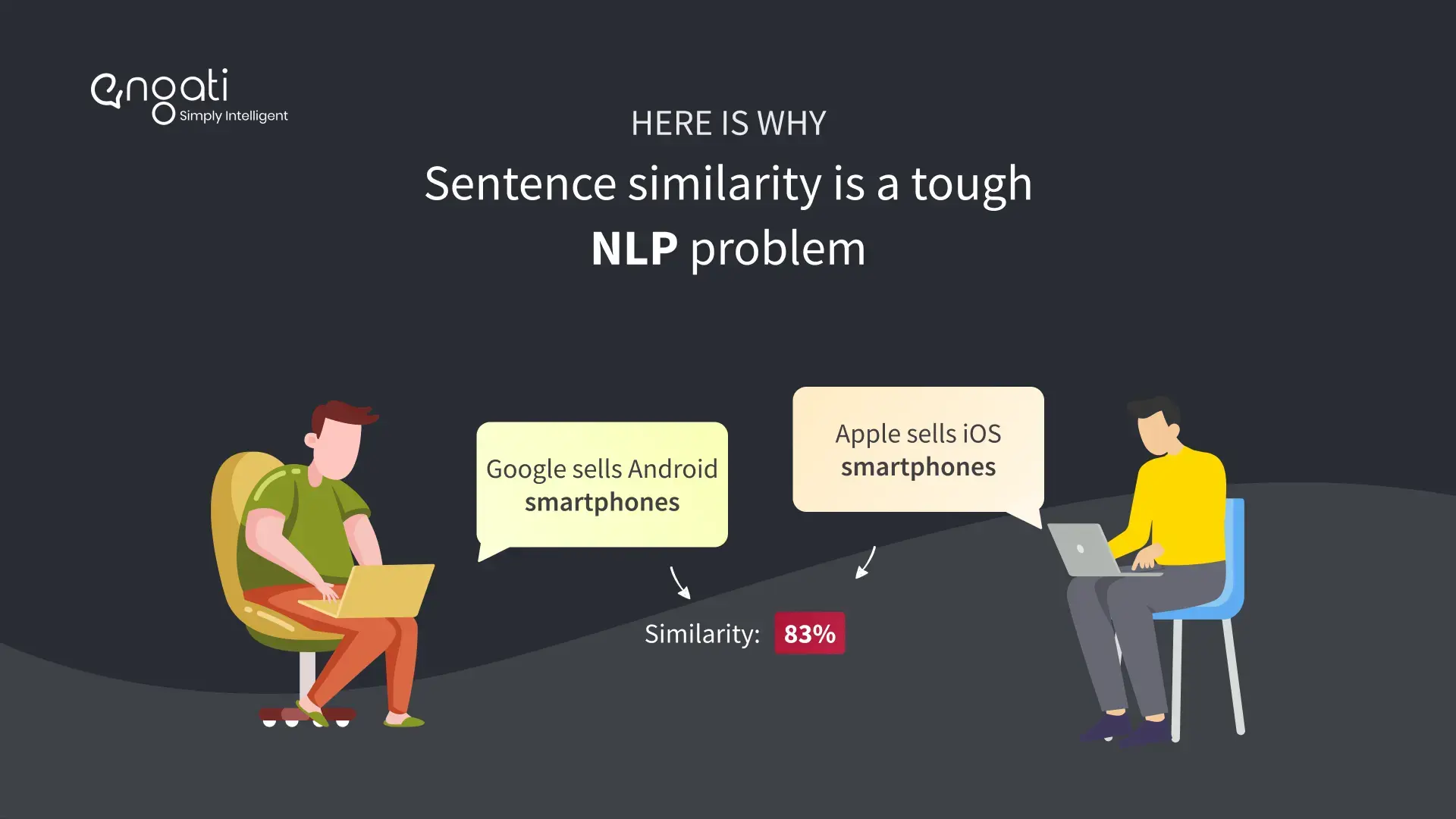
Find out why sentence similarity is a challenging NLP problem and why training computers to read, understand and write language has become a big business.