Whatsapp Marketing
Create WhatsApp Bot for Free in 5 Mins With No Code (2025)
Learn how to create a WhatsApp bot in 5 minutes with easy steps. Discover WhatsApp integration tips, explore use cases & get a chatbot demo with free trail.
Deductive reasoning, also deductive logic, is the process of reasoning from one or more statements (premises) to reach a logical conclusion.
The logical deduction goes in the same direction as that of the conditionals and links premises with conclusions. If all premises are true, the terms are clear, and the rules of deductive logic are followed, then the conclusion reached is necessarily true.
Deductive reasoning ("top-down logic") contrasts with inductive reasoning ("bottom-up logic"): in deductive reasoning, a conclusion is reached reductively by applying general rules which hold over the entirety of a closed domain of discourse, narrowing the range under consideration until only the conclusion(s) remains. In deductive reasoning, there is no uncertainty. In inductive reasoning, the conclusion is reached by generalizing or extrapolating from specific cases to general rules resulting in a conclusion that has epistemic uncertainty.
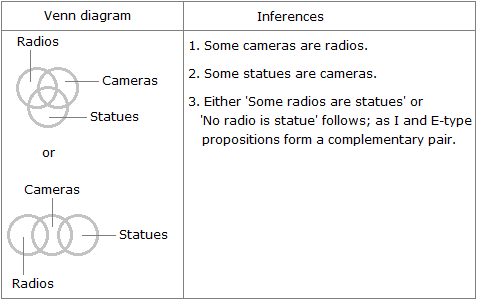
In Logic, any categorical statement is termed as the Proposition.
A Proposition (or a categorical statement) is a statement that asserts that either a part of, or the whole of, one set of objects - the set identified by the subject term in the sentence expressing that statement - either is included in, or is excluded from, another set - the set identified by the predicate term in that sentence.
The standard form of a proposition is :
Quantifier + Subject + Copula + Predicate
Thus, the proposition consists of four parts :
A proposition is said to have a universal quantity if it begins with a universal quantifier, and a particular quantity if it begins with a particular quantifier. Besides, propositions that assert something about the inclusion of the whole or a part of one set in the other are said to have affirmative quality, while those which deny the inclusion of the whole or a part of one set in the other are said to have a negative quality. Also, a term is distributed in a proposition if it refers to all members of the set of objects denoted by that term. Otherwise, it is said to be undistributed. Based on the above facts, propositions can be classified into four types :
1. Universal Affirmative Proposition (denoted by A): It distributes only the subject i.e. the predicate is not interchangeable with the subject while maintaining the validity of the proposition.
2. Universal Negative Proposition (denoted by E): It distributes both the subject and the predicate i.e. an entire class of predicate term is denied to the entire class of the subject term, as in the proposition.
3. Particular Affirmative Proposition (denoted by I): It distributes neither the subject nor the predicate.
4. Particular Negative Proposition (denoted by O): It distributes only the predicate. e.g., Some animals are not wild. Here, the subject term 'animals' is used only for a part of its class and hence is undistributed while the predicate term 'wild' is denied in entirety to the subject term and hence is distributed.
A syllogism is a kind of logical argument that applies logic deduction in order to arrive at a conclusion based on two propositions that are asserted or assumed to be true. Deductive reasoning usually follows steps. First, there is a premise, then a second premise, and finally an inference. A common form of deductive reasoning is the syllogism, in which two statements — a major premise and a minor premise — reach a logical conclusion. For example, the premise "Every A is B" could be followed by another premise, "This C is A." Those statements would lead to the conclusion "This C is B." Syllogisms are considered a good way to test deductive reasoning to make sure the argument is valid.
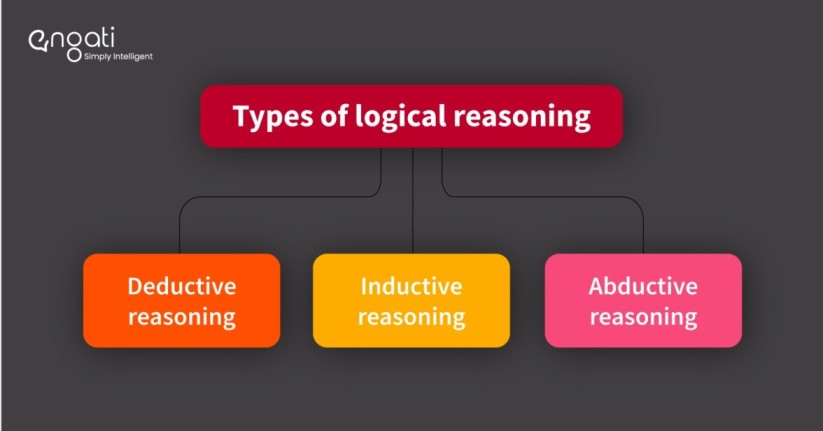
During the scientific process, deductive reasoning is used to reach a logical true conclusion. Another type of reasoning, inductive, is also used. Often, people confuse deductive reasoning with inductive reasoning and vice versa. It is important to learn the meaning of each type of reasoning so that proper logic can be identified.
Deductive reasoning is a basic form of valid reasoning. Deductive reasoning, or deduction logic, starts out with a general statement, or hypothesis, and examines the possibilities to reach a specific, logical conclusion, according to California State University. The scientific method uses deduction to test hypotheses and theories.
Inductive reasoning is the opposite of deductive reasoning. Inductive reasoning makes broad generalizations from specific observations. Basically, there is data, then conclusions are drawn from the data.
Another form of scientific reasoning that doesn't fit in with inductive or deductive reasoning is abductive. Abductive reasoning usually starts with an incomplete set of observations and proceeds to the likeliest possible explanation for the group of observations, according to Butte College. It is based on making and testing hypotheses using the best information available. It often entails making an educated guess after observing a phenomenon for which there is no clear explanation.

Whatsapp Marketing
Learn how to create a WhatsApp bot in 5 minutes with easy steps. Discover WhatsApp integration tips, explore use cases & get a chatbot demo with free trail.

Whatsapp Marketing
Send WhatsApp message template that fits all your business needs. Learn how to create, customize & download 100+ high-converting message templates for free.

Drive to Reimagine
We're showing you the best ways to run marketing campaigns and reach your customers in a more effective manner on their favourite touchpoint - WhatsApp.