Drive to Reimagine
Chatbot business predictions - Future of chatbots
A chatbot is a designed tool powered by the rules of Artificial Intelligence (AI), acts as a simulator of human conversation for the purpose of automating a bus
PCI compliance is compliance with the Payment Card Industry Data Security Standard (PCI DSS). PCI DSS is a set of standards that was created for the purpose of ensuring that every company that processes, stores, or transmits credit card information does so while maintaining a secure environment. SOC 2 which also an importance role and is a much larger regulator body than PCI compliance as it regulates customer data.
PCI compliance is regulated, administered, and managed by the Payment Card Industry Security Standards Council (PCI SSC) which is an independent organization that was established by MasterCard, Visa, American Express, and JCB. The responsibility for enforcing compliance lies with the payment brands and acquirers instead of the PCI Security Standards Council.
PCI DSS is not a law, it’s a standard. But, it’s mandated by the contract that your company signs with the card companies as well as the banks that handle payment processing.
In these contracts, you agree to be subject to fines if you fail to comply with PCI DSS. The fines would be larger for companies that have a higher volume of payments.
The PCI SSC has made the following tools and resources available:
Get your WhatsApp chatbot at just $5 a day
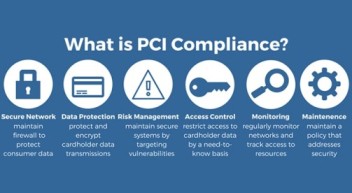
Start nowThere are 12 requirements for PCI DSS compliance. These are:
Firewalls can be considered to be the first line of defense against hackers. They prevent foreign or unknown entities from getting access to private data. They are a major requirement for PCI DSS compliance because of how effective they are at preventing unauthorized access.
A lot of point of sale (POS) systems, modems, routers, and other third-party products tend to have generic passwords and security measures that can easily be bypassed.
A large number of businesses do not even bother to secure these vulnerabilities. To be PCI compliant, you need to create and maintain a list of all your devices and software that need a password or any other security to access. You also need to take precautions and put necessary configurations in place (like changing your password after certain intervals).
This is a two-fold process. First, the card data needs to be encrypted using specific algorithms. The encryption keys themselves also need to be encrypted.
You also need to regularly maintain and scan primary account numbers (PANs) to make sure that there is no unencrypted data.
Cardholder data gets transmitted across several channels. It must be encrypted when it is sent to known locations. Besides, sending this information (especially account numbers) to unknown locations should always be avoided.
All devices that interact with or store primary account numbers need to be protected with antivirus software. The antivirus software should be patched and updated regularly.
Even your POS provider needs to employ antivirus measures where you cannot directly install the software.
You should update all the software that your business uses on a regular basis. However, updating all the software on devices that interact with or store cardholder data is mandatory for compliance purposes.
Data access should be granted solely on a need-to-know basis. Nobody who does not require access to this information should have it
There should be a comprehensive and regularly updated list of the roles that do require access to this data.
Everyone who has access to cardholder data should have their own credentials which they use to access the data. Instances of multiple employees using the same credentials should not arise.
This makes it possible to take action and fix issues faster if your data is compromised.
All cardholder data must be physically stored in secure locations. Access to this location needs to be limited.
You need to maintain a log of all activity dealing with cardholder data and primary account numbers. Document how data flows in your organization and how many times access is needed.
You need to keep a track of who accesses the sensitive information and when they access it. You should also use appropriate software to log access.
You need to scan and test your software, physical locations, and employees for vulnerabilities on a regular basis to reduce the chances of malfunctions, and human error.
The lists of equipment, software, and the employees that have access need to be thoroughly documented. You also need to document how data flows through your company, where you store it, and how you use it after the point of sale.
The benefits of PCI compliance are:
There are 4 PCI DSS compliance levels. These levels are determined by the number of transactions that the organizations handle on a yearly basis. The levels are:
Companies that handle upwards of 6 million transactions on a yearly basis.
Companies that handle between 1 and 6 million transactions annually.
Companies that handle 20,000 to 1 million transactions annually.
Companies that handle less than 20,000 transactions annually.
Drive to Reimagine
A chatbot is a designed tool powered by the rules of Artificial Intelligence (AI), acts as a simulator of human conversation for the purpose of automating a bus
Drive to Reimagine
Chatbots are everywhere today. But what can make your chatbots stand out from the rest? Read this extensive cheatsheet to learn how to build a unique chatbot.

Drive to Reimagine
The concept of ‘Chatbot Theory’, a new core subject, potentially seeks to position the capability in a strategic rather than tactical or technological context.