Tech Corner
Artificial Intelligence - Making work easier than ever!
AI has been a revolution in the world of technology, and it's growing at an exponential pace. But how has Artificial Intelligence made our lives easier?
Anomaly detection is a process in data mining that involves identifying outlier values in a series of data. It assumes that the data we possess falls within a particular understood range, which may be based on historical data, and that values are very rarely found outside of that range.
This process is also known as outlier analysis. In supervised anomaly detection, the data can be labeled to be ‘normal or ‘abnormal’ so that models can be developed and those models can be applied to new data.
In unsupervised machine learning, anomaly detection can be done on unlabeled data by making use of historical data, analyzing the probability distribution of values, and then figuring out whether a new value is unlikely, making it an anomaly.
Anomaly detection can be conducted on single variables (this is known as Univariate Anomaly Detection) as well as on combinations of variables (this is known as Multivariate Anomaly Detection).
There are two fundamental assumptions in anomaly detection:
Anomalies occur very rarely in the data.
There are significant differences in the features of anomalies and those of normal instances.
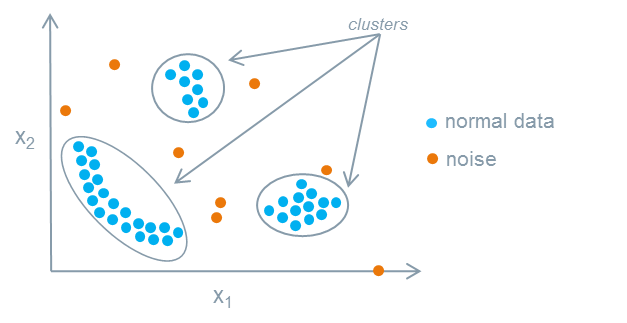
Within datasets, certain patterns show that everything is normal. These patterns represent business as usual.
However, there can be unexpected changes in these data patterns. Sometimes you may notice events that do not conform to the data pattern that is expected. These are known as anomalies. They are essentially deviations from business as usual.
Anomalies are also known as outliers, discordant observations, exceptions, novelties, noise, peculiarities, aberrations, deviations, surprises, or contaminants, depending on the application domain. The terms ‘anomaly’ and ‘outlier’ are the most widely used ones, and they are generally used interchangeably. An anomaly doesn’t necessarily have to be a good or bad thing. They simply are deviations from the usual state of things.
There are essentially three types of anomalies. These are: update anomalies, deletion anomalies, and insertion anomalies.
Get your WhatsApp chatbot at just $5 a day
Start now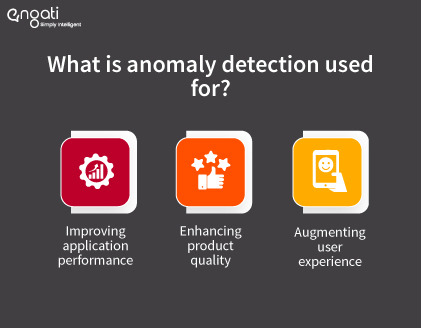
Anomaly detection can be used for a variety of purposes. Here are a few of them:
Traditional approaches to application performance monitoring would only really help you to react to issues after they arise. That means that you would have to deal with the issues arising because of anomalies before you can take any action to fix them.
Using anomaly detection techniques with artificial intelligence and machine learning would help you identify anomalies and fix potential problems before they surface and affect your users and their experience with your application.
It can help you correlate data with the appropriate application performance metrics so that your team knows what to take action on.
It helps you proactively increase the performance of your applications.
From the time to create a product and launch it to every single time you release an update, you need to be sure that your product will function seamlessly, as intended by you.
Any change that you make to your purchase funnel, any update to your features, and any new version of your product can potentially result in behavioral anomalies.
If you don’t proactively look for these anomalies and take the initiative to fix them, your business could end up losing massive amounts of revenue.
Any lapses in your customer experience can cause your customers to get frustrated. This could cause a spike in customer attrition and a drop in your revenues.
Anomaly detection can help you fix this in advance, give your customers and users a seamless experience and keep them loyal to you, thus helping you increase your customer lifetime value.
There are many techniques that can be used for anomaly detection, These include:
The simplest approach involves flagging data points that deviate from the common statistical properties of the distribution (including median, mean, mode, and quantities).
Anomalies can be prevented and resolved by normalizing the database. This is essentially a systematic approach towards decomposing tables and eliminating redundancy, thus getting rid of insertion, modification, and deletion anomalies. Here are the goals of normalization:

Tech Corner
AI has been a revolution in the world of technology, and it's growing at an exponential pace. But how has Artificial Intelligence made our lives easier?
Tech Corner
Deep learning predicts user behavior for Amazon and Netflix suggesting tailored recommendations to boost customer engagement and provide personalised experience

Drive to Reimagine
The hospitality industry is booming. With innumerable travel enthusiasts and bloggers dying to visit new places for a new adventure, it's chatbot time now!