Whatsapp Marketing
Create WhatsApp Bot for Free in 5 Mins With No Code (2025)
Learn how to create a WhatsApp bot in 5 minutes with easy steps. Discover WhatsApp integration tips, explore use cases & get a chatbot demo with free trail.
Automatic Speech Recognition or ASR, as it’s known in short, is the technology that allows human beings to use their voices to speak with a computer interface in a way that, in its most sophisticated variations, resembles normal human conversation.
The most advanced version of currently developed ASR technologies revolves around what is called Natural Language Processing, or NLP in short. This variant of ASR comes the closest to allowing real conversation between people and machine intelligence and though it still has a long way to go before reaching an apex of development, we’re already seeing some remarkable results in the form of intelligent smartphone interfaces like the Siri program on the iPhone and other systems used in business and advanced technology contexts.
The process of automatic speech recognition looks like this:
This is in layman’s terms. The actual process is actually quite tricky as it consists of a series of subtasks such as speech segmentation, acoustic modeling, and language modeling to form a prediction (of sequences of labels) from noisy, unsegmented input data.
Luckily, the introduction of Connectionist Temporal Classification (CTC) removed the need for pre-segmented data and allowed the network to be trained end-to-end directly for sequence labeling tasks like ASR.
As a result, a CTC based ASR pipeline consists of the following blocks, shown below:
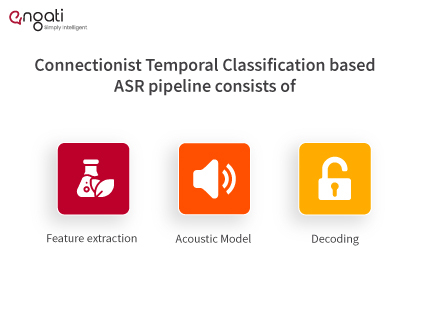
Audio signal preprocessing using normalization, windowing, (log) spectrogram (or mel scale spectrogram, or MFCC).
A CTC-based network that predicts the probability distributions P_t(c) over vocabulary characters c per each time step t.
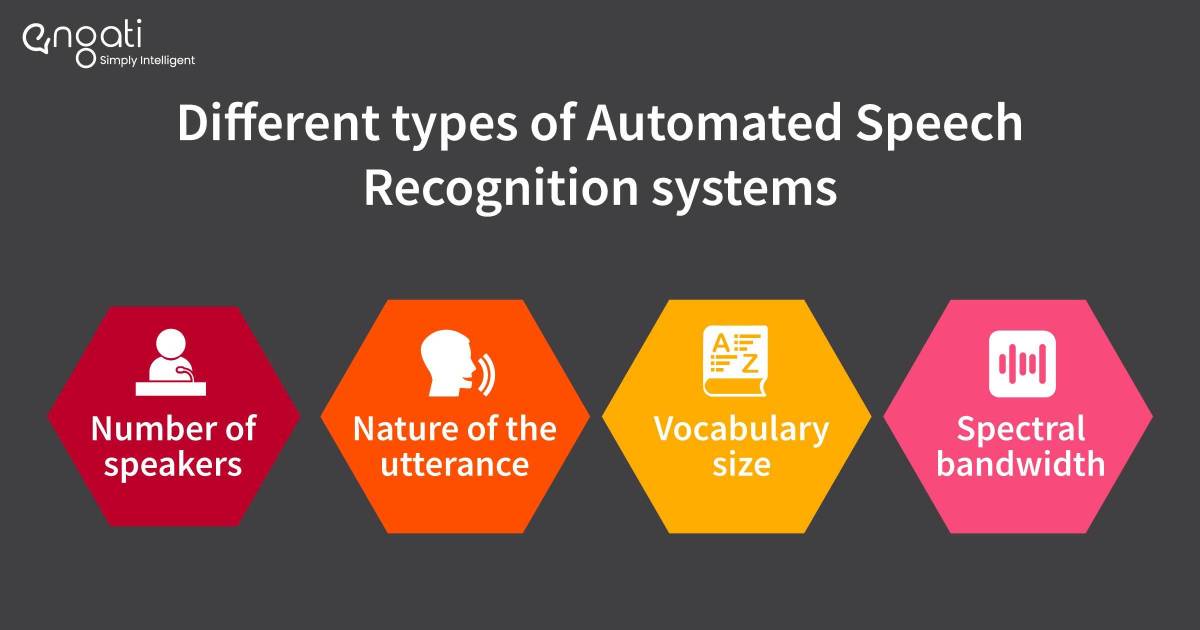
Speech Recognition Systems can be categorized into different groups depending on the constraints imposed on the nature of the input speech.
A system is said to be speaker-independent if it can recognize speech from any and every speaker; such a system has learned the characteristics of a large number of speakers. A large amount of a user’s speech data is necessary for training a speaker-dependent system. Such a system does not recognize other’s speech well. Speaker adaptive systems, on the other hand, are speaker-independent systems to start with but have the capability to adapt to the voice of a new speaker provided a sufficient amount of their speech is provided for training the system. Popular dictation machine is a speaker-adapted system.
A user is required to utter words with clear pauses between words in an Isolated Word Recognition system. A Connected Word Recognition system can recognize words, drawn from a small set, spoken without the need for a pause between words. On the other hand, Continuous Speech Recognition systems recognize sentences spoken continuously. A spontaneous speech recognition system can handle speech disfluencies such as “ah,” “um,” false starts, or grammatical errors present in a conversational speech. A Keyword Spotting System keeps looking for a prespecified set of words and detects the presence of any one of them in the input speech.
An ASR system that can recognize a small number of words (say, 10 digits) is called a small vocabulary system. Medium vocabulary systems can recognize a few hundred words. Large and Very Large ASR systems are trained with several thousand and tens of thousands of words respectively. Examples of application domains of small, medium, and very large vocabulary systems are telephone/credit card number recognition, command, and control, dictation systems respectively.
The bandwidth of telephone/mobile channels is limited to 300-3400Hz and therefore attenuates frequency components outside this passband. Such a speech is called narrowband speech. In contrast, normal speech that does not go through such a channel is call wideband speech; it contains a wider spectrum limited only by the sampling frequency. As a result, the recognition accuracy of ASR systems trained with wideband speech is better. Moreover, an ASR system trained with narrowband speech performs poorly with wideband speech and vice versa.
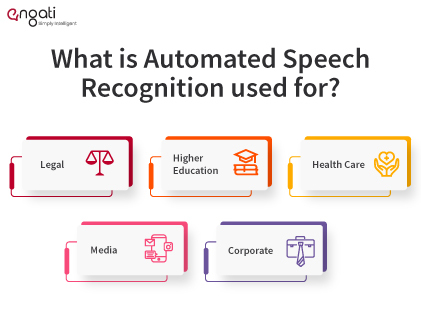
ASR is being used in a variety of industries, such as higher education, legal, finance, government, health care, and media where conversations are continuous and often need to be tracked or recorded word for word.
Some examples:
Whatsapp Marketing
Learn how to create a WhatsApp bot in 5 minutes with easy steps. Discover WhatsApp integration tips, explore use cases & get a chatbot demo with free trail.

Chatbot
Learn from chatbot flowchart examples and discover how to design chatbot conversational flows that lead to more natural and engaging user interactions.

Future of CX
Revolutionize customer support with automation! Our article shows top tools & strategies to save costs & time. Discover how to automate customer support & make