Drive to Reimagine
10 hacks to step up your logistics company's customer experience
Just delivering orders on time isn't good enough anymore. Your logistics company needs to deliver amazing customer experiences too. Here are 10 hacks for you!
A bill of materials (BOM) is essentially a comprehensive inventory of the raw materials, assemblies, subassemblies, parts, and components, including the quantities of each of these that go into manufacturing a product.
To break it down, the BOM is basically an entire list of every single item that is needed for the purpose of manufacturing a product. A bill of materials might also be called a product structure, assembly component list, or production recipe.
It is critical for several manufacturing and supply chain processes like production, materials requirement planning, inventory planning, scheduling, and product costing to be carried out in a smooth and effective manner.
Along with listing the materials, components and parts and their quantities that are needed to manufacture or repair a product, the BOM also makes note of their descriptions and costs.
It also contains instructions for procuring and using these materials. Due to the amount and depth of the data that the bill of materials holds, it can act as a central record of the materials, components, and processes used to manufacture or repair a product.
You could say that it is pretty much a blueprint for manufacturing or repairing a product. It can aid businesses in planning for purchases of materials, estimating costs, planning for and controlling inventory as well as reducing production delays and waste substantially.
If it is prepared well, the bill of materials can assist in identifying the cause of product failure and help the company take action to replace the faulty parts, materials, and components.
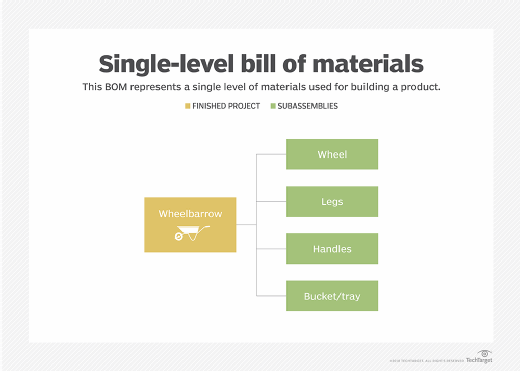
Data from various sources goes into calculating a bill of materials.
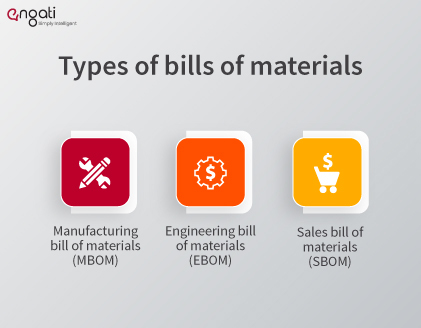
There are three main types of bills of materials. The different types of BOMs have varying structures and levels of detail.
This holds a structured list of all the items or subassemblies required to make a manufactured, shippable finished product. It also contains information about the parts that require processing before assembly and explains how different components relate to one another in a product.
The information contained in the manufacturing bill of materials gets shared with all the integrated business systems involved in procuring and producing the product, including enterprise resource planning (ERP), material requirements planning (MRP), and, sometimes, a manufacturing execution system (MES).
This defines assemblies or parts as designed by the engineering department. It displays the component structure from a functional perspective and tends to be made up of a mechanical or technical drawing of a product. It is quite common to have multiple engineering bills of materials as the design goes through revisions.
The SBOM defines a product in the sales stage. The list of finished products and the components that are required to develop them are mentioned separately in the sales order document. In the sales bill of materials, the finished product is managed as a sales item and not an inventory item.

Drive to Reimagine
Just delivering orders on time isn't good enough anymore. Your logistics company needs to deliver amazing customer experiences too. Here are 10 hacks for you!

Drive to Reimagine
Businesses around the world need to protect themselves, their employees, and customers from the coronavirus pandemic. Here are a few coronavirus precautions.

Drive to Reimagine
Ready your eCommerce business for the future. Reach your customers and drive sales, the channel they use the most with smart WhatsApp chatbots for eCommerce