Drive to Reimagine
8 ways chatbots in banking can improve customer engagement
HDFC, TMNF & 100 others have deployed banking chatbots that give customers financial advice on how to invest, provide info on nearest ATM, account balance
Collaborative filtering (CF) is a technique used by recommender systems. Collaborative filtering has two senses, a narrow one and a more general one.
In the newer, narrower sense, collaborative filtering is a method of making automatic predictions (filtering) about the interests of a user by collecting preferences or taste information from many users (collaborating). The underlying assumption of the collaborative filtering approach is that if a person A has the same opinion as a person B on an issue, A is more likely to have B's opinion on a different issue than that of a randomly chosen person. For example, a collaborative filtering recommendation system for preferences in television programming could make predictions about which television show a user should like given a partial list of that user's tastes.
In the more general sense, collaborative filtering is the process of filtering for information or patterns using techniques involving collaboration among multiple agents, viewpoints, data sources, etc. Applications of collaborative filtering typically involve very large data sets. Collaborative filtering methods have been applied to many different kinds of data including: sensing and monitoring data, such as in mineral exploration, environmental sensing over large areas or multiple sensors; financial data, such as financial service institutions that integrate many financial sources; or in electronic commerce and web applications where the focus is on user data, etc.
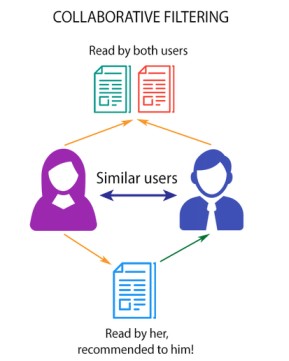
User-based filtering measures the similarity between target users and other users, using logic and recommends items by finding similar users to the active user.
Item-based, which measures the similarity between the items that target users rate or interact with and other items.
Get your WhatsApp chatbot at just $5 a day
Start nowCollaborative filtering tackles the similarities between the users and items to perform recommendations. Meaning that the algorithm constantly find the relationships between the users and in-turns does the recommendations. The algorithm learn the embeddings between the users without having to tune the features. The most common technique is by performing Matrix Factorization to find the embeddings or features that makes up the interest of a particular user.
Matrix factorization is an embedding. Say we have a user-movie matrix or feedback matrix, Aᴺᴹ, the models learns to decompose into:
An user embedding vector U, where row N is the embedding for item M.
An item embedding vector V, where row M is the embedding for item N
The embedding vector is learned such that by performing UVᵀ, an approximation of the feedback matrix, A can be formed.
To approximate the feedback matrix, a loss function is needed. One of the intuitive loss function is using mean squared error (MSE). MSE computes the difference in the feedback matrix A and the approximated UVᵀ matrix.
One of the most common problems with training the model is overfitting. Overfitting happens because the model is trying to learn the embedding of certain features that does not contribute to the accuracy of the model. If this particular outlier feature has large ‘amplitude’ or bias, then it is said that the model is over-fitted to these particular features.
Generally, the steps (and functions) are listed below:
Collaborative filtering systems have many forms, but many common systems can be reduced to two steps:
This falls under the category of user-based collaborative filtering. A specific application of this is the user-based Nearest Neighbor algorithm.
Alternatively, item-based collaborative filtering (users who bought x also bought y), proceeds in an item-centric manner:
No, collaborative filtering is an unsupervised learning which we make predictions from ratings supplied by people. Each rows represents the ratings of movies from a person and each column indicates the ratings of a movie.
In Collaborative Filtering, we do not know the feature set before hands. Instead, we try to learn those. Just like the handwritten digit recognition MNIST, we do not know what features to extract at the beginning but eventually the program learns those latent features (edge. corner, circle) itself.
Content-based filtering, makes recommendations based on user preferences for product features. Collaborative filtering mimics user-to-user recommendations. It predicts users preferences as a linear, weighted combination of other user preferences.
Both methods have limitations. Content-based filtering can recommend a new item, but needs more data of user preference in order to incorporate best match. Similar, collaborative filtering needs large dataset with active users who rated a product before in order to make accurate predictions. Combination of these different recommendation systems called hybrid systems.

Drive to Reimagine
HDFC, TMNF & 100 others have deployed banking chatbots that give customers financial advice on how to invest, provide info on nearest ATM, account balance

Drive to Reimagine
To reap all the benefits of chatbot technology and implement it properly, you first need to understand their potential, the advantages and their limits.

Drive to Reimagine
Chatbot trends for 2023 are out and we've listed down the top 10 chatbot trends that will help you grow your business like never before! Read more here!