Future of CX
Engati AI: Driving Customer Success in the Modern Era
Unlock the key to customer success with Engati's LIVE chat support for chatbots. Take your strategy to the next level and never leave customers frustrated again
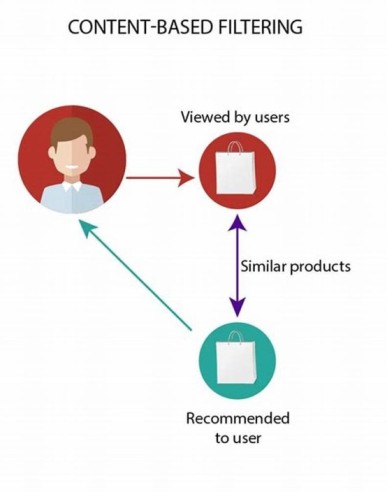
Content-based filtering uses item features to recommend other items similar to what the user likes, based on their previous actions or explicit feedback.
To demonstrate content-based filtering, let’s hand-engineer some features for the Google Play store. The following figure shows a feature matrix where each row represents an app and each column represents a feature. Features could include categories (such as Education, Casual, Health), the publisher of the app, and many others. To simplify, assume this feature matrix is binary: a non-zero value means the app has that feature.
There are 3 component procedures of a Recommender:
Current recommendation systems such as content-based filtering and collaborative filtering use different information sources to make recommendations. Content-based filtering, makes recommendations based on user preferences for product features. Collaborative filtering mimics user-to-user recommendations. It predicts users preferences as a linear, weighted combination of other user preferences.
Both methods have limitations. Content-based filtering can recommend a new item, but needs more data of user preference in order to incorporate best match. Similar, collaborative filtering needs large dataset with active users who rated a product before in order to make accurate predictions. Combination of these different recommendation systems called hybrid systems,
This method of content based filtering revolves completely around comparing user interests to product features. The products that have the most overlapping features with user interests are what’s recommended.
Given the significance of product features in this system, it is important to discuss how the user’s favorite features are decided.
Here, two methods can be used (possibly in combination). Firstly, users can be given a list of features out of which they can choose whatever they identify with the most. Secondly, the algorithm can keep track of the products the user has chosen before and add those features to the users’ data.
Similarly, product features can be identified by the developers of the product themselves. Moreover, users can be asked what features they believe identify with the products the most.
Once a numerical value, whether it is a binary 1 or 0 value or an arbitrary number, has been assigned to product features and user interests, a method to identify similarities between products and user interests needs to be identified. A very basic formula would be the dot product.
Content-based filtering does not require other users' data during recommendations to one user.
Get your WhatsApp chatbot at just $5 a day
Start now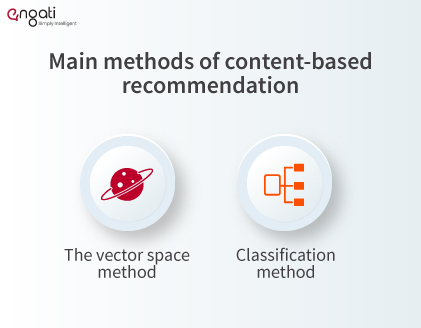
The content-based recommendation system works on two methods, both of them using different models and algorithms. One uses the vector spacing method and is called method 1, while the other uses a classification model and is called method 2.
Let us suppose you read a crime thriller book by Agatha Christie, you review it on the internet. Also, you review one more fictional book of the comedy genre with it and review the crime thriller books as good and the comedy one as bad.
Now, a rating system is made according to the information provided by you. In the rating system from 0 to 9, crime thriller and detective genres are ranked as 9, and other serious books lie from 9 to 0 and the comedy ones lie at the lowest, maybe in minus.
With this information, the next book recommendation you will get will be of crime thriller genres most probably as they are the highest rated genres for you.
For this ranking system, a user vector is created which ranks the information provided by you. After this, an item vector is created where books are ranked according to their genres on it.
With the vector, every book name is assigned a certain value by multiplying and getting the dot product of the user and item vector, and the value is then used for recommendation.
Like this, the dot products of all the available books searched by you are ranked and according to it the top 5 or top 10 books are assigned.
This method of content based filtering was the first one used by a content-based recommendation system to recommend items to the user.
The second method of content based filtering is the classification method. In it, we can create a decision tree and find out if the user wants to read a book or not.
For example, a book is considered, let it be The Alchemist.
Based on the user data, we first look at the author name and it is not Agatha Christie. Then, the genre is not a crime thriller, nor is it the type of book you ever reviewed. With these classifications, we conclude that this book shouldn’t be recommended to you.
Advantages of content-based recommender system are following:
The disadvantage are as follows:

Future of CX
Unlock the key to customer success with Engati's LIVE chat support for chatbots. Take your strategy to the next level and never leave customers frustrated again

Future of CX
Shep Hyken, Colin Shaw, Dan Gingiss and Elise Quevedo talk about customer experience for the future in a free virtual panel discussion. Start reading now!
Future of CX
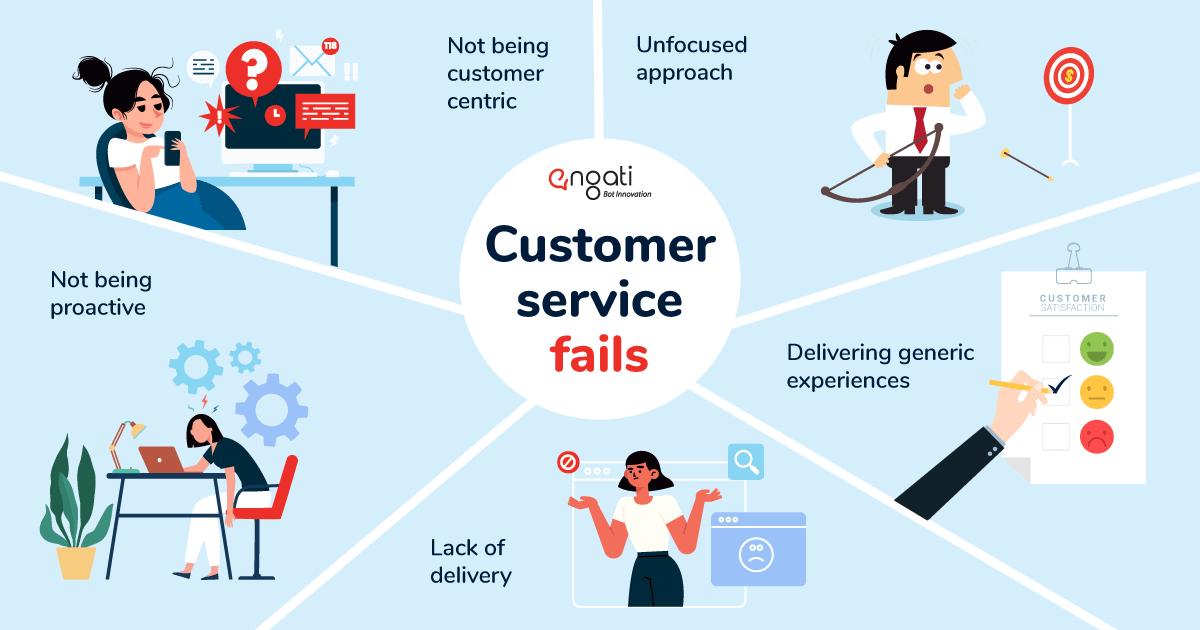
Negligence causes businesses to fail at the customer service game. So, we’ve complied our list of the top customer service fails so that you stay winning.