Future of CX
6 ways to avoid the negativity bias in customer service
What is negativity bias in customer service? How does it affect how your customers perceive your brand? What can you do about it? Deep dive into the topic
Customer experience transformation is the act of enhancing your customer experience substantially by streamlining and improving the interactions that customers have with your business at various touchpoints, and also aligning your entire organization (not just your customer support team) to put customers at the forefront of their activities as far as possible.
It involves becoming a heavily customer-centric organization and delivering the experiences that your customers deserve. It’s about meeting and exceeding customer expectations.
CX transformation is about breaking down silos and creating seamless experiences for your customers.
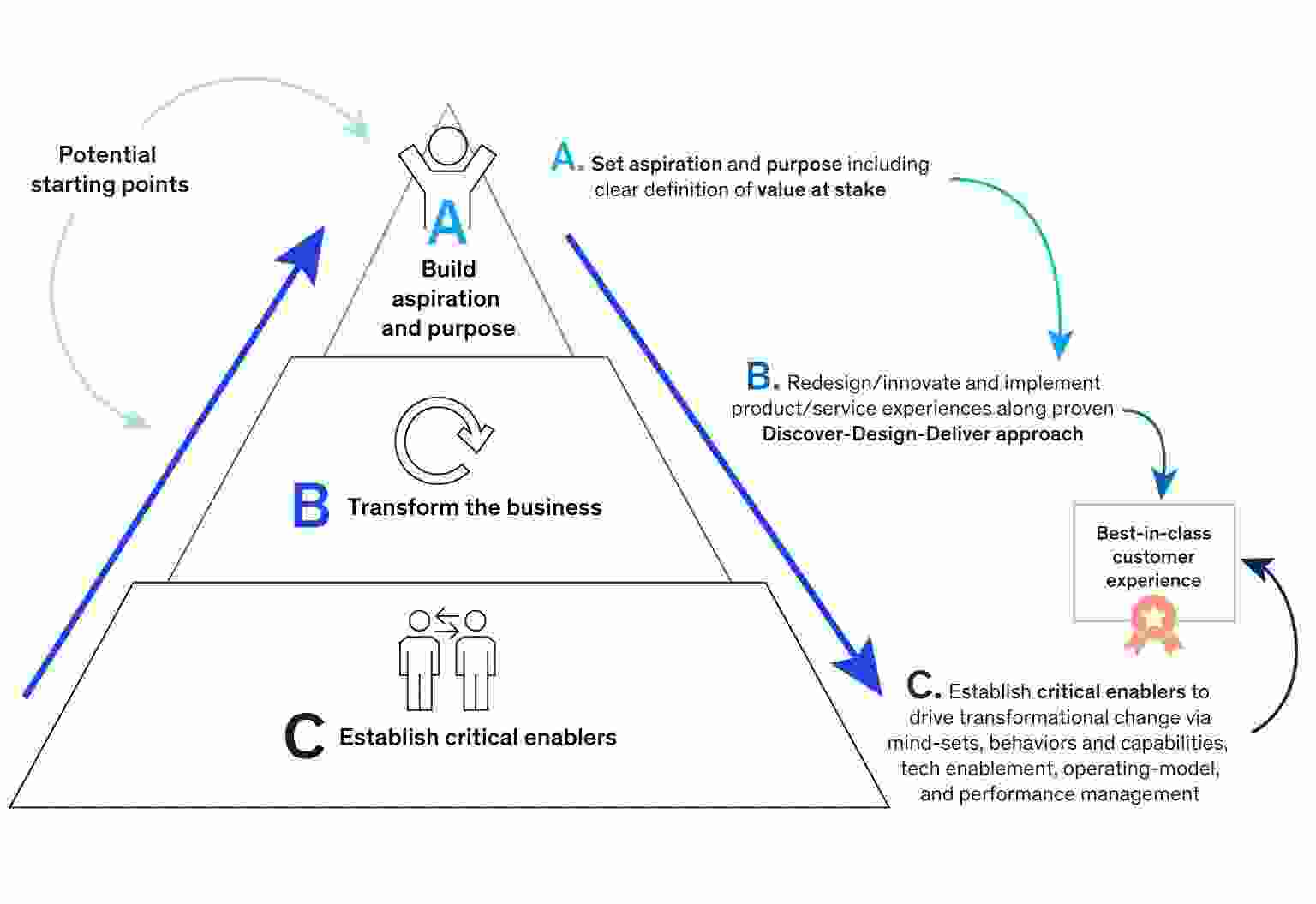
Customer experience transformation is critical especially if you’re noticing customer churn or lower sales levels. It’s usually an indicator that something is wrong with your customer experience.
You need to actively take steps to fix this and transform your customer experience, which will help you increase customer satisfaction, thus boosting your loyalty levels as well.
Customer experience transformation is especially important because most businesses were built keeping the traditional in-person or on-phone customer experience in mind. Functioning like that for decades on end made them rigid and created silos in the company, each responsible for separate functions of the business. They eventually started serving their customers over digital channels, but the silos remained. So they engaged in digital transformation of their business processes but maintained the silos.
The main issue here is that customers interact with businesses over multiple channels and customer touchpoints throughout the customer journey and a siloed structure cannot efficiently and seamlessly handle customer issues and deliver on their expectations across all the channels the customers are served over.
Digital transformation of customer experience is vital in order to create a truly omnichannel experience and serve your customers in the best way possible. Without it you might be able to create fantastic experiences on a single channel, but as soon as they hop across touchpoints you’re in hot water.
You can’t serve your customers the way they deserve and expect to be served by simply using your company’s legacy structure and systems. If you want to create great customer experiences on a consistent basis, you need to create an ecosystem in which customer needs are met quickly and proactively. These experiences need to be well designed, otherwise, you’re just doing it on the fly. In that situation, you might create a few good experiences, but a lot of them would be substandard, and would even frustrate your customers.
In order to create such a CX ecosystem, you need to transform your CX operations and fix the issues that your legacy business practices create, thus engaging in digital business transformation.
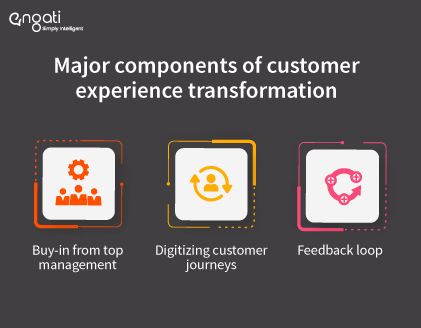
According to McKinsey & Company, there are three major components of CX transformation. These are:
Top management needs to believe in customer-centricity and align towards a vision of enhancing your customer experience, which would rally the entire organization around that vision.
Identify and map out your customer journeys, especially the critical ones. Now you need to work towards redesigning, transforming, and digitizing them.
You need to establish a feedback loop from customers to your employees. Make use of customer feedback to continuously improve your CX.
The elements of CX transformation are:
You need to have a vision of that customer experience that you intend to deliver so that your organization can rally around it. Everyone in your organization must buy into the vision, right from the C-Suite to the entry level employees. Your customer experience transformation cannot be effective if there are people in your organization who are not aligned with it.
Establish a decision structure to prioritize initiatives, especially when there are cross-functional committees and teams involved.
Design a roadmap for the initiatives that you are putting in place to deliver on your CX transformation vision.
You can’t just plan initiatives and go in blindly. You need to have metrics and KPIs in place to help you understand how your initiatives are faring and what results they are bringing.
What are you going to change about how your team works in order to achieve tasks that your current manner of functioning does not allow you to achieve?
Here are a few things you can start doing to transform your customer experience for the better:
Educate and train your customers to make the most out of your offerings. Show them how to gain more value from your products and use your offerings to achieve their version of success.
Customer training could include onboarding, live webinars, and self-paced learning resources like blogs and knowledge bases.
Engage your customers in their own language. If you don’t speak your customers’ language, you are perceived to be an outsider. Get accepted as part of the community by localizing your communications.
You can scale this up for all your regions by using AI-powered multilingual chatbots.
Engage your customers over all the channels they use and carry conversational context across these channels so that your customers do not need to repeat themselves. Customer journeys flow across channels and you should be able to meet them at every touchpoint, retaining context from the previous ones
Don’t send your customers jumping through 15 agents before they reach one that can actually help them. Employ contextual routing to use the data from the customers’ queries and route them to the right agent the very first time so that your customers don’t have to go through multiple agents till they reach someone equipped to help them and handle the issues that they are facing.
You need to invest in a technological infrastructure that enables cross-functional operations and helps you manage the customer experience based on the customer journey.
Customer experience transformation is very essential, it's time to scale your engagements by using intelligent chatbots to handle the repetitive queries, routing only the complex ones to live agents.
Future of CX
What is negativity bias in customer service? How does it affect how your customers perceive your brand? What can you do about it? Deep dive into the topic

Future of CX
MD of Eglobalis Information and co-founder of the ECXO, Ricardo Saltz Gulko talks about the fundamentals for increasing the adoption of technology and services.

Drive to Reimagine
Context understanding can be established for factors like location, sentiment, expression, time, etc. which influences the way how a user interacts with the bot