Tech Corner
AI in Cybersecurity - Uses, Threats & Prevention | 2024
Learn what is artificial intelligence in cybersecurity, its uses, benefits and required skills. Explore cyber threats and learn how to prevent cyber attacks.
A cyber threat refers to any potential danger or risk that could exploit vulnerabilities in computer systems, networks, or digital environments to cause harm or damage. These threats can have various impacts, including data breaches, financial loss, reputational damage, and operational disruptions. Effective cybersecurity practices, including regular updates, user education, and robust security measures, are essential for protecting against these risks.These threats can come from various sources and take different forms, including:
1. Malware: Malicious software like viruses, worms, ransomware, or spyware designed to damage, disrupt, or gain unauthorized access to systems.
2. Phishing: Attempts to trick individuals into providing sensitive information, such as login credentials or financial details, often through deceptive emails or websites.
3. Denial of Service (DoS) Attacks: Overloading a network, server, or service with excessive traffic to make it unavailable to legitimate users.
4. SQL Injection: Exploiting vulnerabilities in a web application's database to execute unauthorized commands or access data.
5. Insider Threats: Threats originating from within an organization, whether intentional or accidental, that involve misuse or abuse of access to sensitive information.
Cyber threats can originate from a variety of sources, each with its own motives and methods. Some common sources of cyber threats include:
1. Cybercriminals: Individuals or groups who engage in illegal activities for financial gain, such as stealing personal information, committing fraud, or deploying ransomware. They often use sophisticated techniques to exploit vulnerabilities and can operate individually or as part of organized crime groups.
2. Hacktivists: Individuals or groups who use hacking as a form of protest or to promote political or social causes. Their goal is often to draw attention to their cause, disrupt services, or leak sensitive information to the public.
3. State-sponsored Actors: Government-affiliated entities or nation-states that conduct cyber espionage, cyber warfare, or other forms of cyber attacks to gain strategic, political, or economic advantages. These actors often have significant resources and technical expertise.
4. Insiders: Employees, contractors, or other individuals with authorized access who may intentionally or unintentionally compromise security. This could involve mishandling data, leaking information, or falling victim to phishing schemes.
5. Cyber Terrorists: Individuals or groups who use cyber attacks to cause fear, disrupt critical infrastructure, or achieve political or ideological objectives. Their attacks can target essential services like power grids or transportation systems.
6. Script Kiddies: Inexperienced individuals who use pre-written scripts or tools to launch attacks without a deep understanding of how they work. While often less skilled, their actions can still cause significant damage.
7. Competitors: Rival companies or business entities may engage in cyber espionage to gain competitive intelligence or disrupt operations. This can involve stealing trade secrets, damaging reputations, or disrupting services.
8. Automated Systems: Bots and automated tools that can scan for vulnerabilities, execute attacks, or distribute malware at scale. These systems can be used by various threat actors, including cybercriminals and hacktivists.
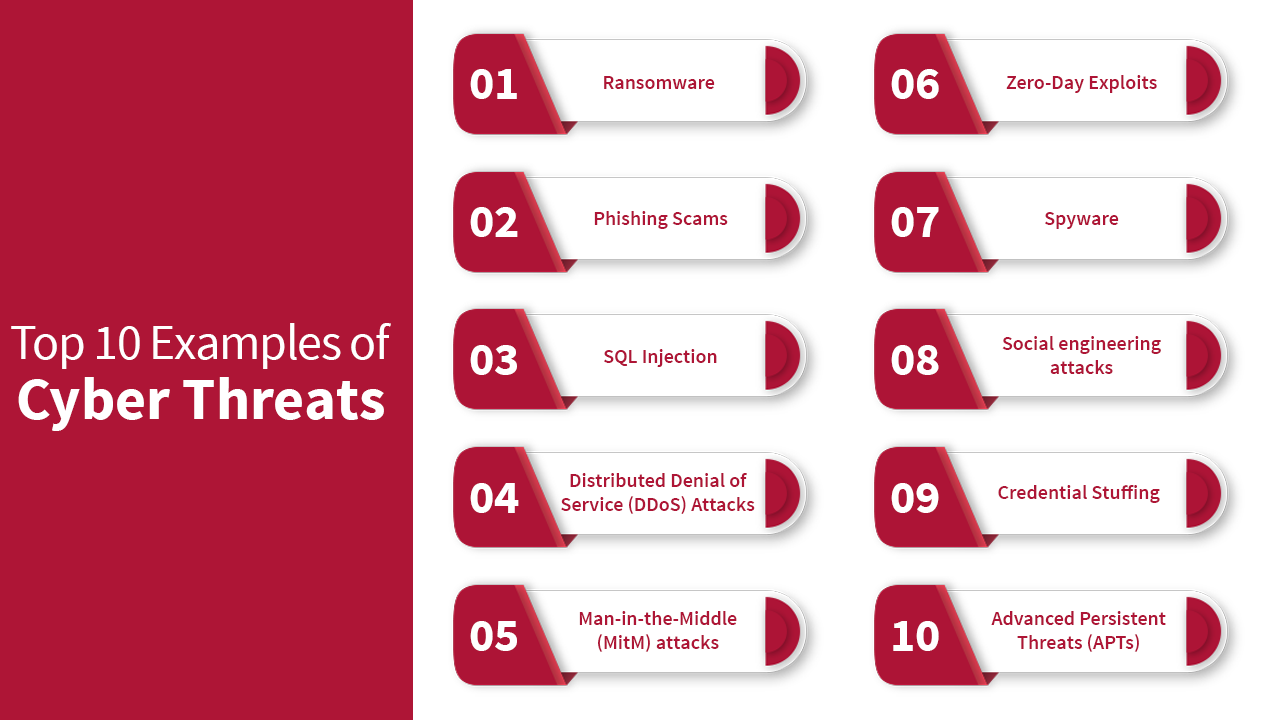
Here are some specific examples of cyber threats, illustrating the various tactics and techniques used by attackers:
1. Ransomware: It is a kind of virus that encrypts a victim's data and requests payment for the decryption key, typically in cryptocurrency. Notable examples include the WannaCry and NotPetya attacks, which caused widespread disruptions and financial losses.
2. Phishing Scams: Deceptive emails or messages that appear to come from legitimate sources, aiming to trick individuals into providing sensitive information or clicking malicious links. For instance, emails claiming to be from a bank asking for account verification details.
3. SQL Injection: An attack where malicious SQL code is inserted into a web application's database query, potentially allowing attackers to access or manipulate sensitive data. An example is the 2017 Equifax breach, where attackers exploited a vulnerability in a web application.
4. Distributed Denial of Service (DDoS) Attacks: Overwhelming a network or service with traffic from multiple sources to render it unavailable. The 2016 Dyn DNS attack is a prominent example, where a massive DDoS attack disrupted internet services across the U.S. and Europe.
5. Man-in-the-Middle (MitM) attacks: Involves listening in on conversations between two parties and maybe changing what is said. An example is an attacker intercepting data transmitted over an unsecured Wi-Fi network, such as login credentials or credit card numbers.
6. Zero-Day Exploits: Attacks that exploit previously unknown vulnerabilities in software before the developer has issued a patch. For example, the Stuxnet worm used zero-day vulnerabilities to target Iran's nuclear program.
7. Spyware: Malicious software designed to gather information about a user or organization without their consent. Examples include keyloggers that capture keystrokes to steal passwords and other sensitive data.
8. Social engineering attacks: Involves manipulating people into disclosing private information. For instance, an attacker might impersonate IT support to trick employees into revealing their passwords.
9. Credential Stuffing: Using stolen usernames and passwords from one breach to attempt logins on other sites. This type of attack takes advantage of individuals who reuse passwords across multiple sites.
10. Advanced Persistent Threats (APTs): Long-term, targeted cyberattacks where an attacker establishes a covert presence in a network to steal data or disrupt operations over an extended period. A well-known example is the APT29 group, also known as Fancy Bear, linked to state-sponsored activities.
As of 2024, the landscape of cyber threats continues to evolve, with several emerging and persistent threats posing significant risks to individuals, organizations, and governments. Here are some of the biggest cyber threats in 2024:
1. Ransomware Attacks: Ransomware remains a top threat, with increasingly sophisticated and targeted attacks. Threat actors are using advanced encryption techniques, double extortion tactics (where they not only encrypt data but also threaten to leak it), and targeting critical infrastructure and healthcare systems.
2. Supply Chain Attacks: Attackers are increasingly targeting vulnerabilities in the software supply chain to compromise multiple organizations simultaneously. The SolarWinds breach of 2020 highlighted the potential impact of such attacks, and they continue to be a major concern.
3. AI-Powered Attacks: The use of artificial intelligence (AI) and machine learning (ML) by cybercriminals is growing. jcan be used to automate attacks, generate convincing phishing emails, and find vulnerabilities more efficiently. Conversely, defenders are also using AI to enhance threat detection and response.
4. Zero-Day Exploits: Exploits targeting unknown vulnerabilities (zero-day vulnerabilities) are becoming more common. The use of zero-day exploits can lead to significant breaches before patches or defenses are available.
5. Deepfakes and Synthetic Media: The creation and use of deep fakes—manipulated media that can be used to deceive or defraud—are rising. These can be used for misinformation campaigns, identity theft, and social engineering attacks.
6. IoT Vulnerabilities: As the Internet of Things (IoT) expands, so do the potential attack vectors. Many IoT devices have weak security, making them targets for exploitation, botnets, and attacks on critical infrastructure.
7. Cloud Security Risks: Misconfigurations and vulnerabilities in cloud services can lead to data breaches and unauthorized access. With more organizations moving to cloud-based environments, securing cloud infrastructure and services is increasingly critical.
8. Cryptocurrency and Blockchain Attacks: As the use of cryptocurrencies and blockchain technology grows, so does the risk of theft, fraud, and vulnerabilities within these systems. This includes attacks on cryptocurrency exchanges, smart contract vulnerabilities, and blockchain network exploits.
9. Insider Threats: Insider threats continue to be a significant concern, with malicious or negligent actions by employees or contractors potentially leading to data breaches or system disruptions.
10. Nation-State Cyber Warfare: Geopolitical tensions have led to increased cyber activities by nation-states targeting other governments, critical infrastructure, and private sector organizations. These attacks can include espionage, sabotage, and disruptive operations.
Cybersecurity solutions are diverse and designed to protect systems, networks, and data from various types of cyber threats. Effective cybersecurity often involves a combination of technologies, practices, and policies. Here are some cybersecurity solutions:
1. Firewalls
2. Antivirus and Anti-Malware Software
3. AI in Cybersecurity
4. Encryption
5. Identity and Access Management (IAM)
6. Security Information and Event Management (SIEM)
7. Endpoint Protection
8. Vulnerability Management
9. Backup and Recovery
10. Security Training and Awareness
Protecting sensitive data, digital assets, and the integrity of online systems requires expertise in the vital and ever-evolving field of cybersecurity. It is critical to use a multi-layered strategy that incorporates cutting-edge technologies, strong policies, and proactive practices in order to counteract the increasingly complex and widespread cyber threats. Organizations and people may minimize the risks associated with the changing digital landscape and improve their defense against possible assaults by incorporating solutions such as firewalls, encryption, threat detection systems, and ongoing employee training.
Tech Corner
Learn what is artificial intelligence in cybersecurity, its uses, benefits and required skills. Explore cyber threats and learn how to prevent cyber attacks.

All Categories
Learn how to use WhatsApp AI to re-engage dormant leads, revive stalled conversations, boost conversions, and turn missed opportunities into revenue..

Conversation AI
Explore the rise of silent commerce and how customer preferences are shifting toward messaging, while voice continues to play a key role in engagement.