All Categories
WhatsApp AI for Re-Engaging Dormant Leads: A Playbook
Learn how to use WhatsApp AI to re-engage dormant leads, revive stalled conversations, boost conversions, and turn missed opportunities into revenue..
Facial recognition is an AI-driven method of verifying the identity of an individual by using their facial features. To identify people in photos, videos, or in real-time is the main use of a Facial recognition system. It is widely used for security purposes.
Technologies for this may vary, but here are the basic steps to it:
Step 1: From a photo or video a picture of your face is captured. Your face might be shown alone or in a crowd. It may show you looking straight ahead or turned to one of your sides.
Step 2: The geometry of your face is been read thoroughly by the Facial recognition software. Some of the key factors include - the distance between your eyes and the distance between your forehead and chin. The software identifies significant facial landmarks (some systems identify 68 of them) that play an important role in distinguishing your face from others. The result: your facial signature gets prepared digitally.
Step 3: Your facial signature is now a derived mathematical formula which is then compared to a database of known faces. At least 117 million Americans have images of their faces in one or more police databases. According to a May 2018 report, the American FBI has access to 412 million facial images for investigative purposes.
Step 4: A determination is made out of it. Your faceprint is made to match that of an image in the system database.
A lot of people and organizations use this software system and for a lot of different purposes. Here’s an example:
Automatic Facial recognition systems can monitor people coming and stepping into airports. The Department of Immigration agency has used the technology to spot those who have overstayed their visas or could also be under criminal investigation. Customs officials at Washington Dulles International Airport made their first arrest using identity verification in August 2018, catching an impostor trying to enter the country.
Apple first used identity verification to unlock its iPhone X and continues the same with the iPhone XS. Face ID authenticates — it makes sure you’re indeed yourself after you attempt to access the device. Apple says the possibility of a random face unlocking your phone is about one in 1 million.
The software can, in essence, take a roll call. If you choose to bunk class, your professor could know.
Facebook uses an algorithm to identify faces once you upload a photograph to its platform. The social media company asks if you would like to tag people in your photos. If you say yes, it creates a link to their profiles. Facebook can recognize faces with 98 percent accuracy.
Some companies have traded in security badges for identity verification systems. Beyond security, it may be a technique to urge some face time with their bosses.
Churches have used automatic Facial recognition to scan their congregations to determine who’s present. It’s an honest effort to track regulars and not-so-regulars, to further help tailor donation requests.
Retailers can combine surveillance cameras and biometric authentication to scan the faces of shoppers. One goal: Identifying suspicious characters and potential shoplifters.
You would possibly be conversant about having an agent scan your boarding card at the gate to board your flight. Although, a minimum of one airline scans your face as well.
Marketers often consider demographics and psychographics like gender, age, and ethnicity when targeting certain groups for a product or idea. Automatic Facial recognition is often accustomed to define those audiences even at an event like a concert.
When we discuss automatic Facial recognition tools, some recognition algorithms include principal component analysis using eigenfaces, linear discriminant analysis, elastic bunch graph matching using the Fisherface algorithm, the hidden Markov model, the multilinear subspace learning using tensor representation, and therefore the neuronal motivated dynamic link matching. There are others too, but their use depends on your aim of using the system.
One of the foremost significant applications of face detection, however, is automatic Facial recognition. It describes a biometric technology that goes way beyond recognizing when somebody's face is present. It actually attempts to determine whose face it is. This method works by employing a computer software application that captures a digital image of an individual’s face (sometimes taken from a video frame) and compares it to photographs in every database of stored records. While biometric authentication isn’t 100% accurate, it can very closely and accurately determine when there's a powerful chance that a person’s face matches someones within the database.

All Categories
Learn how to use WhatsApp AI to re-engage dormant leads, revive stalled conversations, boost conversions, and turn missed opportunities into revenue..

Conversation AI
Explore the rise of silent commerce and how customer preferences are shifting toward messaging, while voice continues to play a key role in engagement.
AI Agents
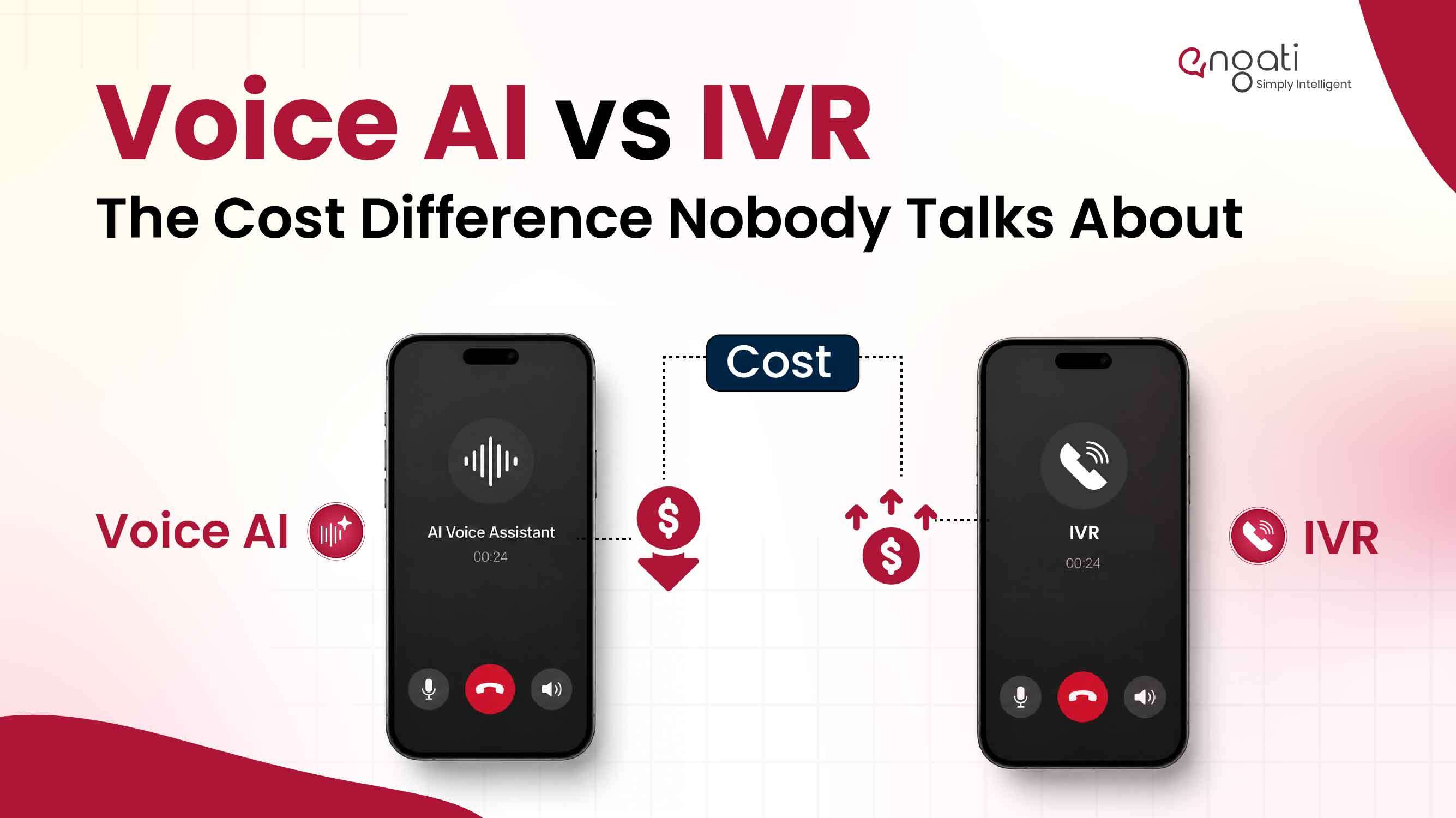
Compare Voice AI and IVR costs beyond setup and licensing. Learn how automation, containment rates, customer experience, and scalability impact ROI for you.