Whatsapp Marketing
Create WhatsApp Bot for Free in 5 Mins With No Code (2025)
Learn how to create a WhatsApp bot in 5 minutes with easy steps. Discover WhatsApp integration tips, explore use cases & get a chatbot demo with free trail.
Information retrieval (IR) is the process of obtaining information system resources that are relevant to an information need from a collection of those resources. Searches can be based on full-text or other content-based indexing. Information retrieval is the science of searching for information in a document, searching for documents themselves, and also searching for the metadata that describes data, and for databases of texts, images or sounds.
Automated information retrieval systems are used to reduce what has been called information overload. An Information Retrieval system is a software system that provides access to books, journals, and other documents; stores and manages those documents. Web search engines are the most visible IR applications.
Data is the big game now. Huge amount of data is generated on a daily basis. But this data is actually useless, if there is no way to obtain and query the data, the information we collect is useless. Information retrieval system is critical for making sense of data. Without Google or any other search engines, it would have been very difficult to retrieve any information off the internet.
Text indexing and retrieval systems index data in data repositories and allow users to search against it. Retrieval systems provide users with online access to information that they may not be aware of. Users are able to query all information that the administrator has decided to index with a single search.
Librarians, professional searchers, etc., engage themselves in the activity of information retrieval but nowadays hundreds of millions of people engage in IR every day when they use web search engines. Information Retrieval is believed to be the dominant form of Information access. The IR system assists the users in finding the information they require but it does not explicitly return the answers to the question. It notifies regarding the existence and location of documents that might consist of the required information. Information retrieval also extends support to users in browsing or filtering document collection or processing a set of retrieved documents. The system searches over billions of documents stored on millions of computers. A spam filter, manual or automatic means are provided by the Email program for classifying the mails so that they can be placed directly into particular folders.
An IR system has the ability to represent, store, organize, and access information items. A set of keywords are required to search. Keywords are what people are searching for in search engines. These keywords summarize the description of the information.
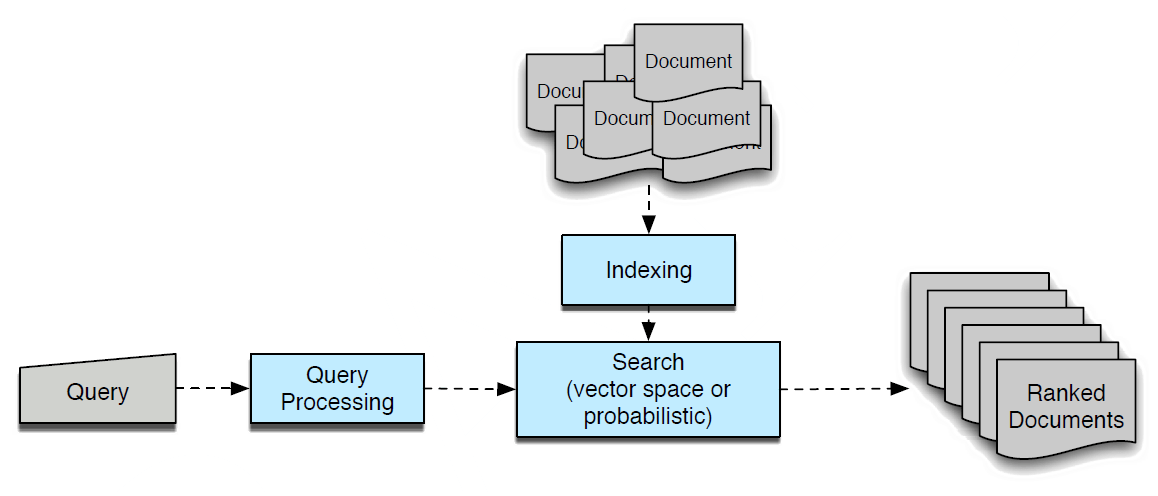
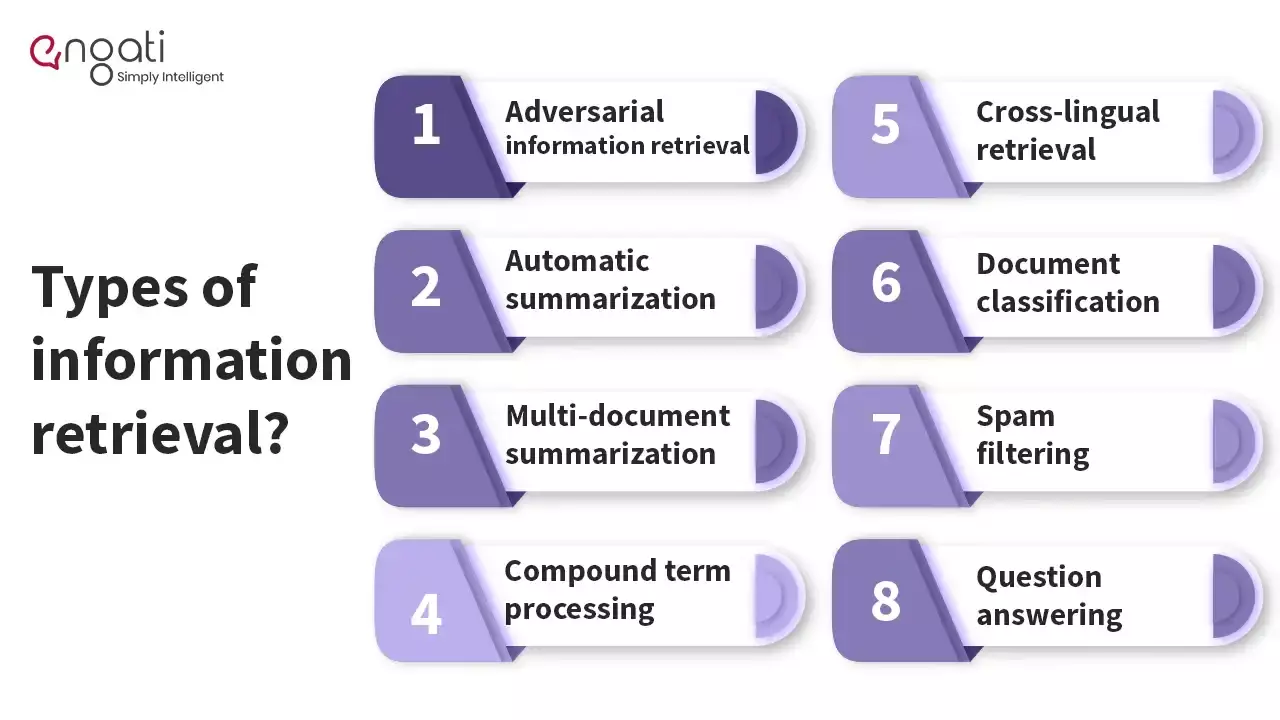
Methods/Techniques in which information retrieval techniques are employed include:
When you ask your librarian in your school, they quickly find out the book which you need from hundreds of other books segregated into various sections or types. This is a kind of Information retrieval. Now imagine inputting a similar search query on web search engines, which goes through billions of pages and resources to find out the result of your query. Information Retrieval is believed to be the dominant form of Information access. The IR system assists the users in finding the information they require but it does not explicitly return the answers to the question. Just like your librarian who might recommend a few other books to you in the same genre. It notifies regarding the existence and location of documents that might consist of the required information.
An IR system has the ability to represent, store, organize, and access various information items. A set of keywords are required to search. Keywords are what people are searching for in search engines. These keywords summarize the description of the information.
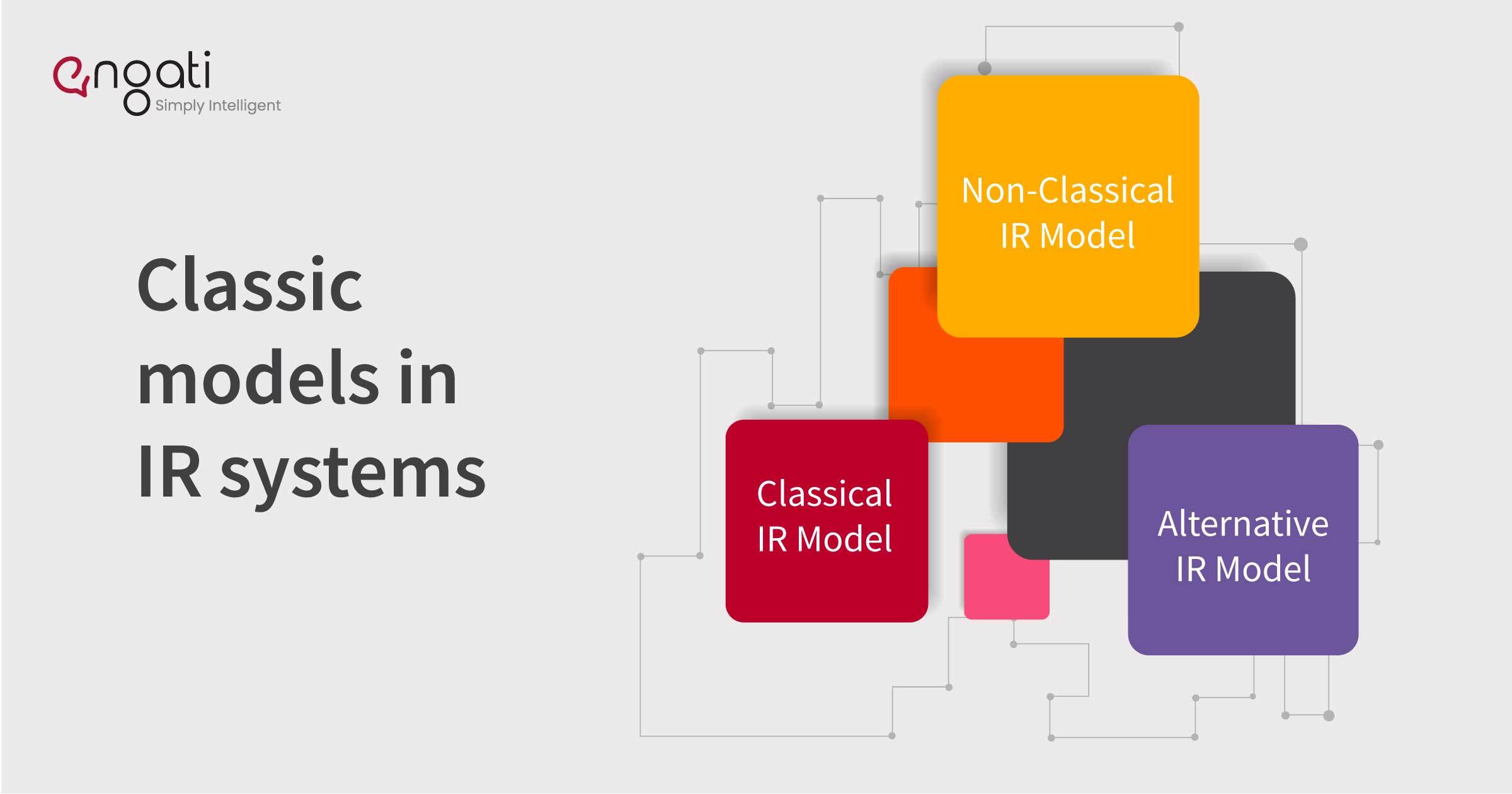
An information model (IR) model can be classified into the following three models −
It is the simplest and easy to implement IR model. This model is based on mathematical knowledge that was easily recognized and understood as well. Boolean, Vector and Probabilistic are the three classical IR models.
It is completely opposite to the classical IR model. Such kinds of IR models are based on principles other than similarity, probability, Boolean operations. Information logic model, situation theory model, and interaction models are examples of non-classical IR models.
It is the enhancement of the classical IR model making use of some specific techniques from some other fields. Cluster model, fuzzy model, and latent semantic indexing (LSI) models are the example of alternative IR model.
There are 12 characteristics of an Information Retrieval model:
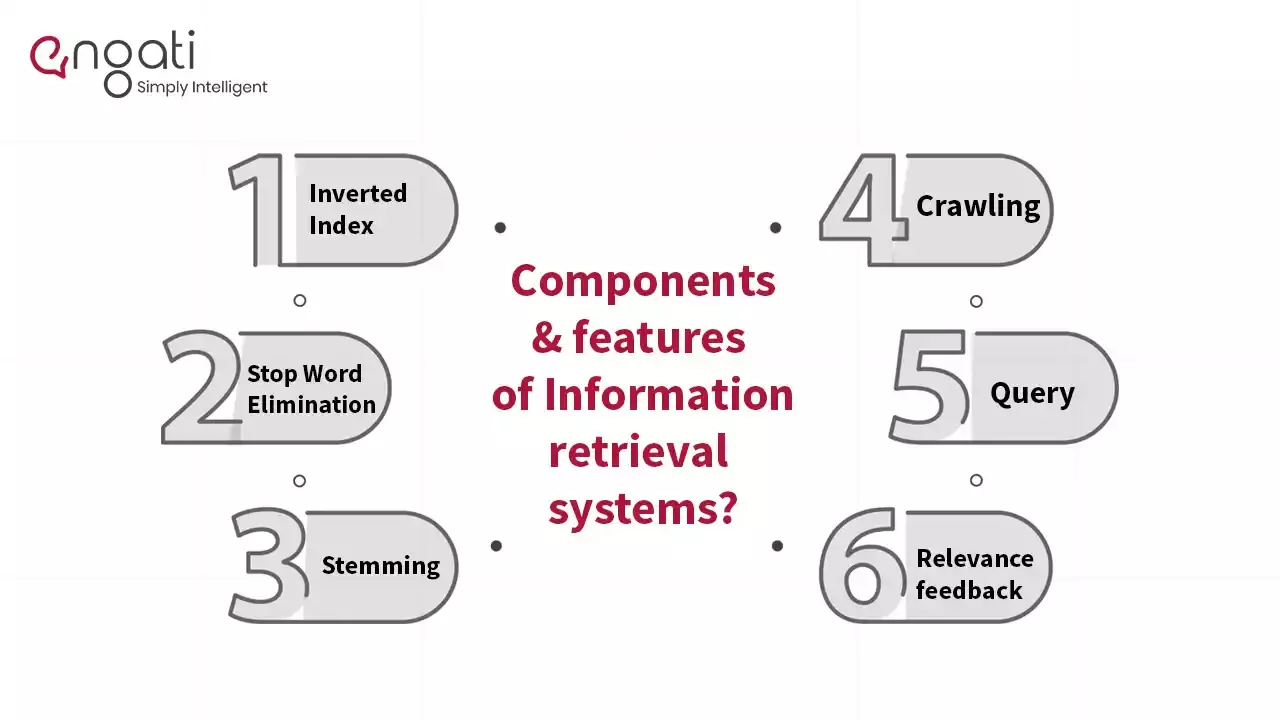
The primary data structure of most of the IR systems is in the form of inverted index. We can define an inverted index as a data structure that list, for every word, all documents that contain it and frequency of the occurrences in document. It makes it easy to search for ‘hits’ of a query word.
Stop words are those high frequency words that are deemed unlikely to be useful for searching. They have less semantic weights. All such kind of words are in a list called stop list. For example, articles “a”, “an”, “the” and prepositions like “in”, “of”, “for”, “at” etc. are the examples of stop words. The size of the inverted index can be significantly reduced by stop list. As per Zipf’s law, a stop list covering a few dozen words reduces the size of inverted index by almost half. On the other hand, sometimes the elimination of stop word may cause elimination of the term that is useful for searching. For example, if we eliminate the alphabet “A” from “Vitamin A” then it would have no significance.
Stemming, the simplified form of morphological analysis, is the heuristic process of extracting the base form of words by chopping off the ends of words. For example, the words laughing, laughs, laughed would be stemmed to the root word laugh.
Crawling is the process of gathering different web pages to index them to support a search engine. The purpose of crawling is to quickly and efficiently gather as many relevant web pages as possible and together with the link structure that interconnects them.
Queries are search statements which describe the information requirements in search engines. A query will never identify one particular result, it will find many results which match the query with different degrees.
Relevance feedback helps in taking results that are initially returned from a specific query, to gather user feedback, and determine whether those results are relevant to perform a new query.
Retrieval Precision and recall are two metrics used to evaluate the performance of an information retrieval system, such as a search engine. Precision is the fraction of relevant results returned by the system, while recall is the fraction of relevant results that the system was able to return. In other words, precision measures the accuracy of the results returned, while recall measures the completeness of the results. A system with high precision returns fewer results, but they are more likely to be relevant. A system with high recall returns more results, but they are less likely to be relevant. For example, if a search engine returns 100 results and 80 of them are relevant, then the precision is 80%. On the other hand, if the search engine was able to return all 200 relevant results, then the recall would be 100%.
Information retrieval has has many wide spread applications which can be categorized into three types.
Data retrieval ( a database management system or DBMS) usually works with structured data with well-defined semantics, IR deals with completely unstructured data. DBMS returns the exact or no result at all if no exact match is discovered. An IR system will yield various results with rankings. Information retrieval systems are likely to go unnoticed, but even a single error would be detected as a complete failure.
Information retrieval (IR) services are computer-based systems that allow users to search and retrieve documents, websites, and other types of information from a database or a collection of documents. These services are designed to help users find relevant information quickly and efficiently.
There are several types of IR services, including:
IR services use various techniques to index and retrieve information, including keyword searches, natural language processing, and machine learning algorithms. They may also use metadata, such as author names, publication dates, and subject tags, to help users find relevant information.
Information storage and retrieval refers to the processes of storing and accessing information in a computer system or database. These processes are essential for organizing and managing large amounts of data, and they allow users to quickly and easily access the information they need.
There are several methods for storing and retrieving information, including:
Regardless of the method used, effective information storage and retrieval systems should be efficient, reliable, and secure. They should also be easy to use and allow users to access and retrieve the information they need quickly and easily

Whatsapp Marketing
Learn how to create a WhatsApp bot in 5 minutes with easy steps. Discover WhatsApp integration tips, explore use cases & get a chatbot demo with free trail.
Whatsapp Marketing
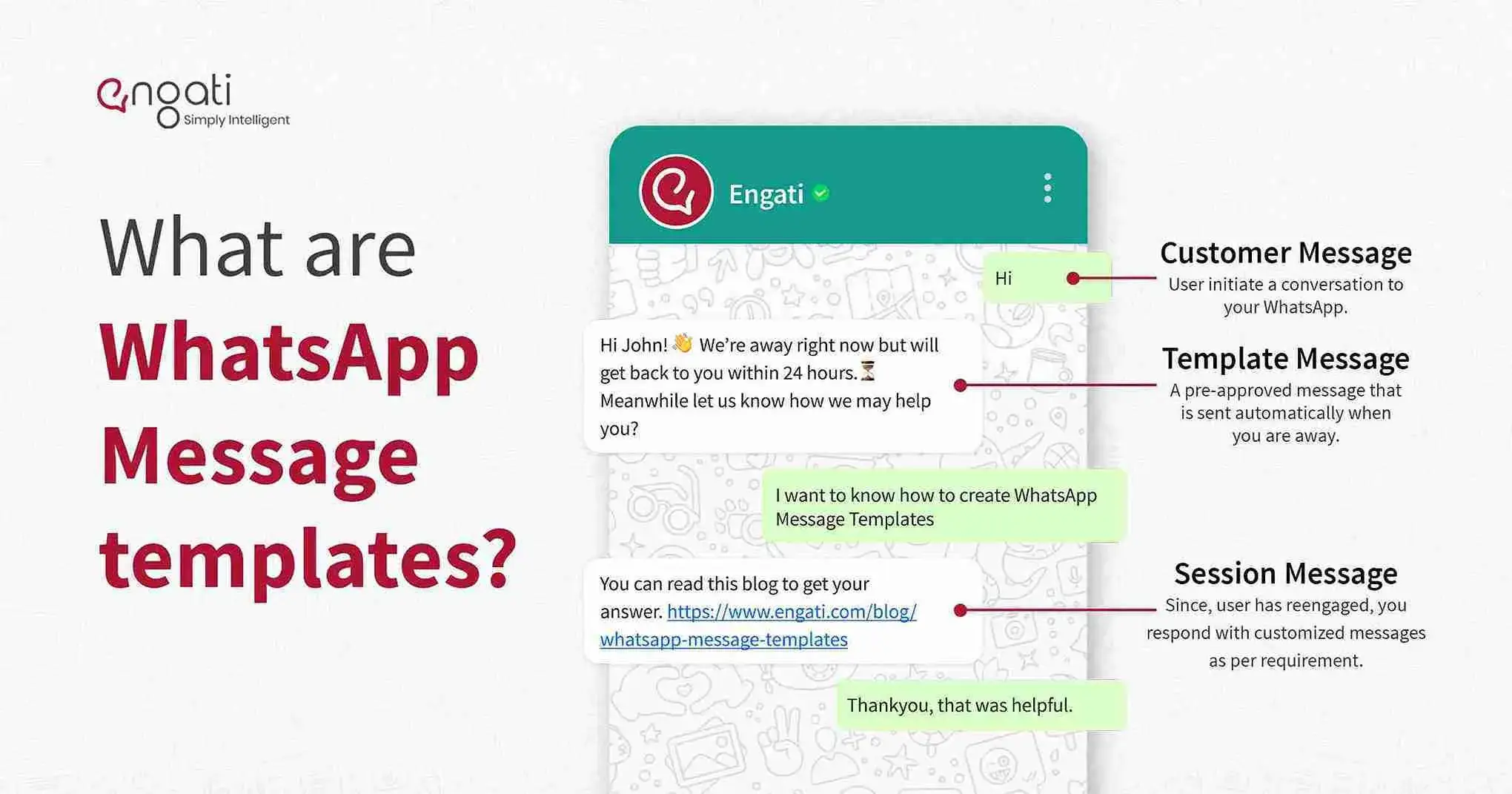
Send WhatsApp message template that fits all your business needs. Learn how to create, customize & download 100+ high-converting message templates for free.

Drive to Reimagine
We're showing you the best ways to run marketing campaigns and reach your customers in a more effective manner on their favourite touchpoint - WhatsApp.