Drive to Reimagine
How chatbots have evolved with data and AI
We've evolved from using rules-based chatbots to exploring more sophisticated chatbots because of data, AI, and NLP. Explore the history and uses in this blog.
A query language is a specialized programming language for searching and changing the contents of a database. Essentially, a query language is a computer programing language that is used for the purpose of retrieving information or data from a database. Even though the term originally refers to a sublanguage for only searching (querying) the contents of a database, modern query languages such as SQL are general languages for interacting with the DBMS, including statements for defining and changing the database schema, populating the contents of the database, searching the contents of the database, updating the contents of the database, defining integrity constraints over the database, defining stored procedures, defining authorization rules, defining triggers, etc.
The data definition statements of a query language provide primitives for defining and changing the database schema, while data manipulation statements allow populating, querying, as well as updating the database. Queries are usually expressed declaratively without side effects using logical conditions.
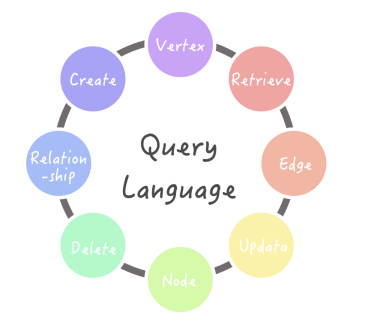
Early query langauges were extremely complicated, which meant that only specially trained individuals could interact with electronic databases. But the interfaces have evolved and have now become far more user friendly, thus making it possible for casual users to access database information.
The most popular types of query modes are the menu, the “fill-in-the-blank” technique, and the structured query. The menu is the best option for novices as it just requires them to simply pick from a range of alternatives that is displayed on the screen. The fill-in-the-blank technique prompts the user to enter key words as search statements. The structured query approach is very effective when it is used on relational databases. It has a formal, powerful syntax that is actually a programming language, and it has the ability to accommodate logical operators. One implementation of the structured query approach, the Structured Query Language (SQL), has the form:
select [field Fa, Fb, . . ., Fn]
from [database Da, Db, . . ., Dn]
where [field Fa = abc] and [field Fb = def].
Structured query languages enable database searching and other operations by making use of commands like “find,” “delete,” “print,” “sum,” etc. The sentencelike structure of an SQL query bears resemblance to natural language, but the difference is that its syntax is limited and fixed.
If you do not want to use an SQL statement, it is possible for you to represent queries in a tabular format. This technique is known as query-by-example (or QBE). It displays an empty tabular form and expects the searcher to fill in the search specifications into the right columns. The program will then construct an SQL-type query from the table and execute it.
If you’re looking for the most flexible natural language, that would have to be natural language. Some commercial database management software permit the use of natural-language sentences in a constrained form for the purpose of searching databases. Such software will parse the syntax of the query, identify its action words and their synonyms, detect the names of files, records, and fields, and execute the logical operations that are needed. There have even been experimental systems developed to take these natural-language queries in spoken voice, but greater advances in machine understanding of natural language, especially in techniques of representing the semantic and pragmatic context of ideas will be needed in order to use unrestricted natural language to query unstructured information.
Data Query Language (DQL) is part of the base grouping of SQL sub-languages. These sub-languages are mainly categorized into four categories: a data query language (DQL), a data definition language (DDL), a data control language (DCL), and a data manipulation language (DML). Sometimes a transaction control language (TCL) is argued to be part of the sub-language set as well.
DQL statements are used for performing queries on the data within schema objects. The purpose of DQL commands is to get the schema relation based on the query passed to it.
Although often considered part of DML, the SQL SELECT statement is strictly speaking an example of DQL. When adding FROM or WHERE data manipulators to the SELECT statement the statement is then considered part of the DML.
Query language in DBMS is primarily created for creating, accessing and modifying data in and out from the database management system (DBMS). Typically, QL requires users to input a structured command that is similar and close to the English language querying construct.
For example, the SQL query: SELECT * FROM
The customer will retrieve all data from the customer records/table.
The simple programming context makes it one of the easiest programming languages to learn. There are several different variants of QL and it has wide implementation in various database-centered services such as extracting data from deductive and OLAP databases, providing API based access to remote applications and services and more.

Drive to Reimagine
We've evolved from using rules-based chatbots to exploring more sophisticated chatbots because of data, AI, and NLP. Explore the history and uses in this blog.

Tech Corner
Data is currently scattered in most enterprises. Data scientists & developers are working on a common framework. Read on to learn how chatbots are helping!

Future of CX
AI can help you give your customers what they actually want, if you use it right. Learn how to use it to make your organization more customer-centric.