Tech Corner
Optimizing Solr Resources with G1
This article is focused on tunning G1 GC params in Solr and tell how blibli.com‘s search gained huge performance gains with limited resources by tweaks.
Situation calculus is a logic formalism that was designed for the purpose of representing and reasoning about dynamical domains.
It was first introduced in the year 1963 by the computer scientist and cognitive scientist, John McCarthy.
The main idea behind it is that reachable states (which we refer to as situations) can be defined in terms of the actions that are required to be done in order to reach those states. What holds true in a situation can be defined in terms of relations, using the situation as an argument.
Essentially, you can pretty much consider situational calculus to be the feature-based representation of actions.
Only single agents, a fully observable environment, and deterministic actions are considered here.
Situations can be associated with states. There are two critical differences between situations and states. These are:
A situation is either:
There are some do(A,S) terms that do not correspond to any state. But in some cases, an agent will need to reason about such a (potential) situation without possessing any knowledge about whether A is possible in state S, or if S is possible at all.
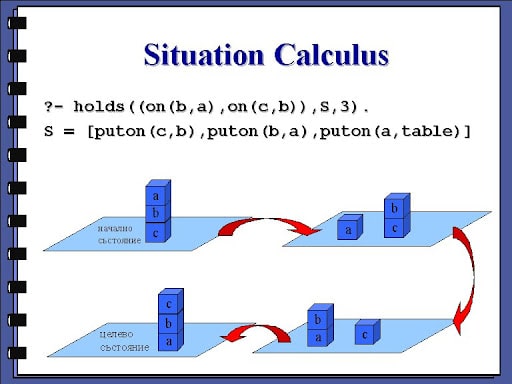
Knowledge representation has a critical role in artificial intelligence. Knowledge representation and reasoning (KR, KRR) is the area in artificial intelligence that is concerned with thinking and how thinking contributes to the intelligent behavior of artificially intelligent systems.
It involves taking real-world information and presenting it in a form that computers can understand, process, and utilize for the purpose of solving real-world problems or handling real-world tasks.
Knowledge representation basically makes understanding, interpreting, and reasoning possible for machines. It also describes how you can represent knowledge in artificial intelligence. It isn’t limited to storing data in a database; it also allows intelligent machines to learn from that knowledge and those experiences, which makes it possible to behave intelligently like a human.
To put it simply, knowledge representation is very important because it enables machines to behave like humans by empowering AI-powered machines to learn from available information, experience, or experts.
The kind of knowledge that needs to be represented in AI-powered systems involves:
The ontology of the situation calculus is made up of situations, actions, and fluents.
A situation can essentially be considered to be an instantaneous snapshot of the world. These are logical terms that are made up of the initial situation and all the situations that arise because of the application of an action to a situation.
A fluent could be anything whose value can be changed. These are essentially functions and predicates that ary from one situation to another. A fluent has the value true if it holds in a situation, it has the value false if it does not hold in the situation. Atemporal or external functions are also permitted. Some examples of these are the predicate Gold (G1), and the function LeftLegOf(Wumpus)).
The simplest version of situation calculus has each action being defined by two axioms. One of them is a possibility axiom and the other is the effect maximum.
The possibility axiom tells us when it is possible to execute the action and the effect axiom tells us what happens when the possible action is executed.
The frame problem in AI illustrates an issue that arises when using first-order logic (FOL) to express facts about a robot in the world. Trying to represent the state of a robot with traditional first-order language makes it necessary to use many axioms that simply imply that things in the environment do not change arbitrarily.
The problem was first defined by John McCarthy and Patrick J. Hayes in an article they published in 1969, Some Philosophical Problems from the Standpoint of Artificial Intelligence. The problem was pretty much a starting point for a large number of general discussions about the difficulty involved in knowledge representation for artificial intelligence.
The frame problem is pretty much a problem of identifying sufficient and appropriate collections of axioms to make it possible to have a viable description of a robot environment.
This problem occurs even in rather simple domains. The problem lies in the fact that specifying only which conditions are changed by the actions does not entail that all other conditions are not changed. It can be solved by incorporating frame axioms. These frame axioms clearly specify that all conditions which aren’t affected by actions are not changed while executing that action.
One of these frame axioms is required for every pair of action and condition such that the action does not affect the condition. It’s a problem of formalizing a dynamical domain without explicitly specifying the frame axioms.
Towards the end of the 1980s, the frame problem, as it was defined by Hayes and McCarthy was solved.
The frame problem is solved in various formalisms. Here is a list of some of the solutions that depict how the problem is solved:

Tech Corner
This article is focused on tunning G1 GC params in Solr and tell how blibli.com‘s search gained huge performance gains with limited resources by tweaks.

Tech Corner
Any e-commerce search engines rely on parameters such as product popularity, rating, click through rate etc to influence the result set for an input user query.

Drive to Reimagine
HDFC, TMNF & 100 others have deployed banking chatbots that give customers financial advice on how to invest, provide info on nearest ATM, account balance