Tech Corner
Contrastive Learning in NLP
Contrastive learning is used to train a model to learn representations of images or sentences using vectors. We'll explore how it works in this article.
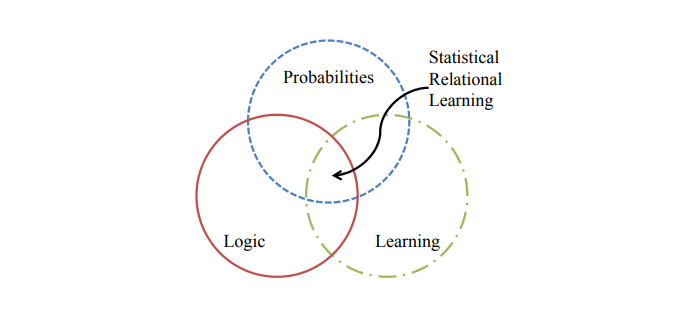
Statistical relational learning (SRL) is a subdiscipline of artificial intelligence and machine learning that is concerned with domain models that exhibit both uncertainty (which can be dealt with using statistical methods) and complex, relational structure.
It is also sometimes known as probabilistic inductive logic programming. Specifically, statistical relational learning deals with machine learning and data mining in relational domains where observations may be missing, partially observed, or noisy. In doing so, it addresses one of the central questions of artificial intelligence – the integration of probabilistic reasoning with machine learning and first-order and relational representations – and deals with all related aspects such as reasoning, parameter estimation, and structure learning.
Statistical relational learning examines techniques that merge the strengths of relational learning and probabilistic learning. By using the power of logic and probability together, these systems are able to carry out robust and accurate reasoning and learning on complex relational data.
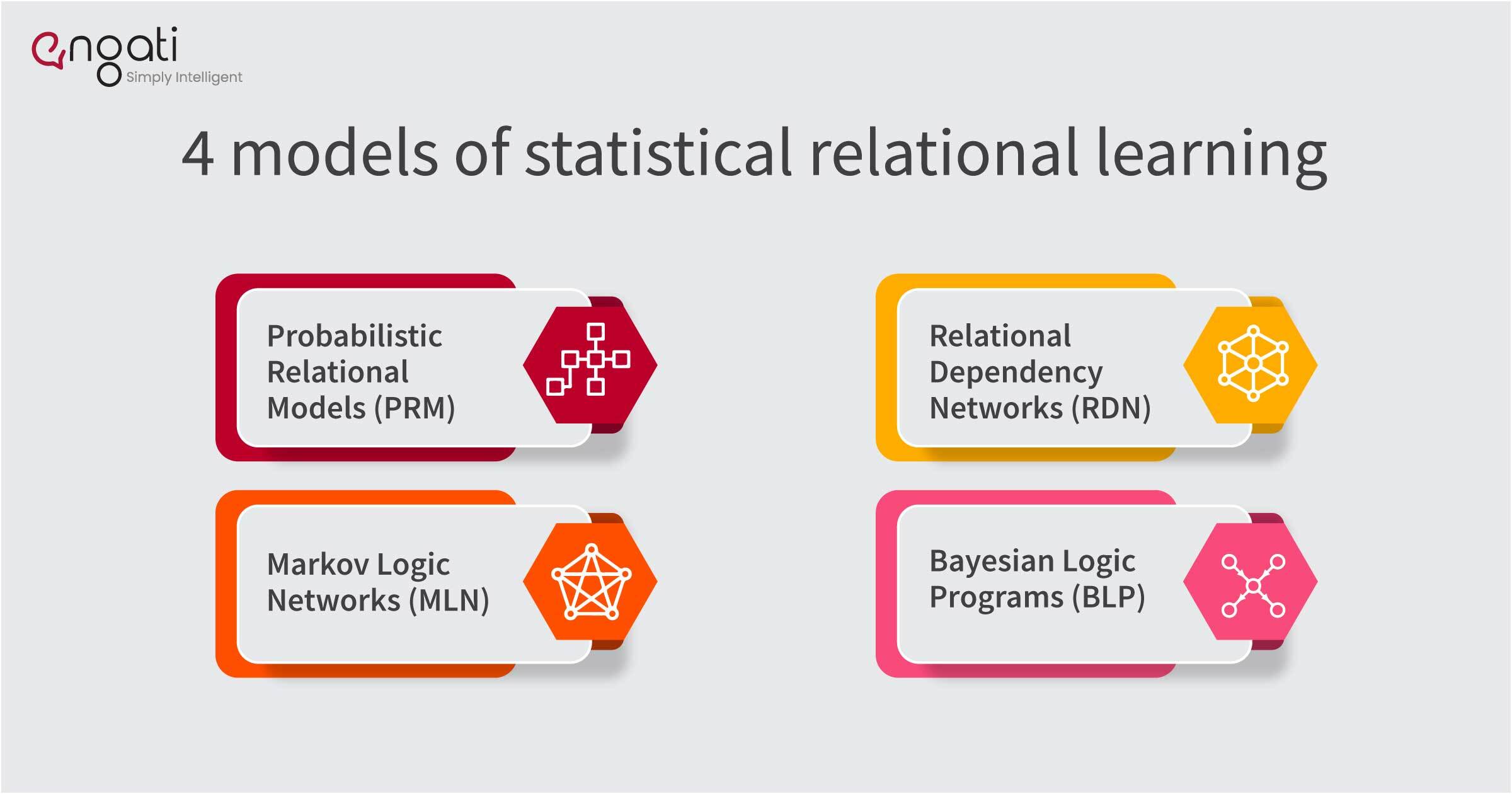
There are 4 main Models in statistical relational learning.
This is a language that is used for the purpose of describing statistical models over typed relational domains.
This is a probabilistic logic which applies the ideas of a Markov network to first-order logic, enabling uncertain inference.
These are graphical models which extend dependency networks to account for relational data.
These are made up of two components. The first is the logical component that comprises a set of Bayesian clauses which captures the qualitative structure of the domain and has its basis in "pure" Prolog. The second component is the quantitative component which encodes the quantitative information regarding the domain and makes use of the notions of a conditional probability table (CPT) as well as a combining rule.
Statistical Relational Artificial Intelligence (StarAI) combines logical (or relational) AI and probabilistic (or statistical) AI. Relational AI deals very effectively with complex domains involving many and even a varying number of entities connected by complex relationships, while statistical AI manages well the uncertainty that derives from incomplete and noisy descriptions of the domains. Both fields achieved significant successes over the last thirty years. Relational AI laid the foundation of knowledge representation and has significantly broadened the application domain of data mining especially in bio- and chemo-informatics.
It now represents some of the best-known examples of scientific discovery by AI systems in the literature. Statistical AI, in particular the use of probabilistic graphical models, has revolutionized AI, too, by exploiting probabilistic independencies. The independencies specified in such models are natural, provide structure that enables efficient reasoning and learning, and allow one to model complex domains. Many AI problems arising in a wide variety of fields such as machine learning, diagnosis, network communication, computational biology, computer vision, and robotics have been elegantly encoded and solved using probabilistic graphical models.
However, both fields evolved largely independently until about fifteen years ago, when the potential originating from their combination started to emerge. Statistical Relational Learning (SRL) was proposed for exploiting relational descriptions in statistical machine learning methods from the field of graphical models. Languages such as Markov Logic Networks, Relational Dependency Networks, PRISM, Probabilistic Relational Models, ProbLog allow the user to reason and learn with models that describe complex and uncertain relationships among domain entities.
Statistical Relational Learning combines first order logic and machine learning methods for probabilistic inference. Although many Natural Language Processing tasks (including text classification, semantic parsing, information extraction, coreference resolution, and sentiment analysis) can be formulated as inference in a firstorder logic, most probabilistic firstorder logics are not efficient enough to be used for largescale versions of these tasks.
Representing and reasoning about unbounded sets of entities and relations has generally been considered a strength of predicate logic. However, NLP also requires integrating uncertain evidence from a variety of sources in order to resolve numerous syntactic and semantic ambiguities. Effectively integrating multiple sources of uncertain evidence has generally been considered a strength of Bayesian probabilistic methods and graphical models. Consequently, NLP problems are particularly suited for SRL methods that combine the strengths of first-order predicate logic and probabilistic graphical models.
Statistical relational learning has several applications in a wide range of areas like web search and mining, text mining, bioinformatics, data mining, natural language processing, transfer learning, as well as abductive reasoning.

Tech Corner
Contrastive learning is used to train a model to learn representations of images or sentences using vectors. We'll explore how it works in this article.

Tech Corner
Deep learning is a breakthrough technology to process and make sense of unstructured data. We have to invest in and make it better to augment our intelligence.
Tech Corner
Deep learning predicts user behavior for Amazon and Netflix suggesting tailored recommendations to boost customer engagement and provide personalised experience