
Drive to Reimagine
8 ways chatbots in banking can improve customer engagement
HDFC, TMNF & 100 others have deployed banking chatbots that give customers financial advice on how to invest, provide info on nearest ATM, account balance
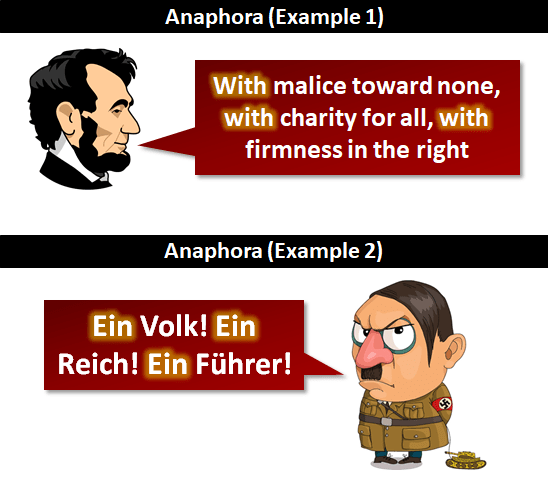
Anaphora refers to making use of a grammatical substitute like a pronoun or a pro-verb to the denotation of a preceding word or a group of words. It is essentially the discourse-level linguistic phenomenon of abbreviated subsequent reference. The most frequently used anaphors happen to be pronouns.
Anaphora plays a critical role in human processors’ product and distribution of texts. Because of this, appropriately recognizing and resolving anaphora is vital for information retrieval systems that manipulate texts which are in natural language. The studies conducted at Syracuse University have provided necessary baseline data regarding the extent to which anaphora occur, their likelihood of referring to concepts integral to the topic, their effect on various term-weighting schemes, and their impact on retrieval results.
The most effective methods of processing anaphora has not yet been determined, but in any case, it is still suggested that enhanced information retrieval systems will be required to represent the full meaning of natural language documents. This includes anaphoric references along with all other discourse linguistic phenomena.
Huang categorizes anaphora into two syntactic categories: noun phrase- (including noun-) anaphora and verb phrase-anaphora. But the issue is that these two classes happen to be far too broad and unspecific for computational tasks.
Mitkov attempts to classify them further by assigning more weight to the computational aspect of anaphora resolution. Mitkov distinguishes between pronominal anaphora, lexical noun phrase anaphora, noun anaphora, verb anaphora, adverb anaphora, and zero anaphora. But these categories become too vague from a linguistic point of view.
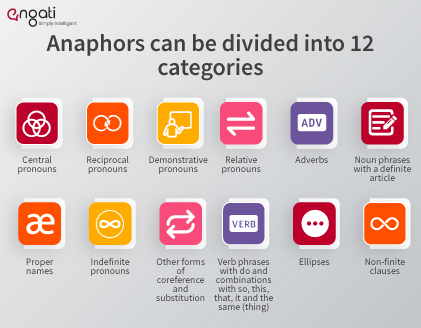
Anaphors can be divided into 12 categories:
This includes personal, possessive, and reflexive pronouns. These three kinds of pronouns form one category because they belong to each other more than the other kinds of pronouns do. These pronouns all differentiate between person, number, and gender. The characteristics of person, number, and gender don’t just unite central pronouns; they even have a vital role in identifying the antecedent since anaphors and their antecedents usually have to show concord in these three features.
There are only two forms of reciprocal pronouns: ‘each other’ and ‘one another’. Both of these are coreferential with their antecedent. Reciprocal pronouns are related to and resemble reflexive pronouns because they express a ‘two-way reflexive relationship’.
These include ‘this’, ‘that’, ‘these’, and ‘those’. Demonstrative pronouns are used either dependently or independently. Regarding the dependent function, they work as a determinative or a modifier.
Regarding grammatical characteristics, demonstrative pronouns differentiate between forms for number. There is a clear distinction between The singular forms this and that for count nouns in the singular and for mass nouns, and the plural forms these and those for count nouns in the plural.
The forms for this type of pronouns are who, whom, which, whose, that, and zero that. In addition to their anaphoric function relative pronouns also form a part of a relative clause.
The items that are included in this category are here, there, then, where, when, while, and why. Here and there tend to denote spatial relations, then denotes temporal orientation, and the others are relative adverbs with where for local relations, when and while for temporal ones, and why for causal relations.
These adverbs tend to display coreference in the relationship between anaphor and antecedent
These are not as typical anaphors as personal pronouns are. They have a head which is the central element of noun phrases and which generally tends to be preceded by a determinative. It is possible to modify noun phrases, either before the head as a premodifier or after the head as a postmodifier.
This too is not a prototypical type of anaphor. Most of these are noun phrases but their heads have peculiar grammatical features since they generally show no number contrast.
The items belonging to indefinite pronouns are one(s), other(s), another, both, all, each, enough, several, some, any, either, neither, none, many & much/more/most, few/fewer/fewest, little/less/least.
There are Some additional forms of substitution that are not indefinite pronouns and do not
fall into any of the other categories. These are ‘the same’ and ‘so’. ‘Such’ happens to be a case of coreference.
These items are the present tense forms do, does, the past tense form did, the present participle (-ing) form doing and the past participle (-ed) form done. Except the non-finite forms doing and done, the preceding items possess corresponding negative forms, either contracted or not, which are don’t/do not, doesn’t/does not, didn’t/did not.
This is where the anaphor is realized by a gap referring to an antecedent. The items that were left out need to occur in the text. It excludes ellipsis where the interpretation comes
from the situational context.
These too aren’t prototypical examples of anaphors. the frequency of non-finite clauses plays a role. Non-finite clauses are reductive devices and so shorten clauses as they are more compact.
Anaphora resolution (AR) refers to the problem of resolving references to earlier or later items in the discourse. These items tend to be noun phrases representing objects in the real world called referents. They can also be verb phrases, whole sentences, or paragraphs.

Drive to Reimagine
HDFC, TMNF & 100 others have deployed banking chatbots that give customers financial advice on how to invest, provide info on nearest ATM, account balance

Drive to Reimagine
To reap all the benefits of chatbot technology and implement it properly, you first need to understand their potential, the advantages and their limits.

Drive to Reimagine
Chatbot trends for 2023 are out and we've listed down the top 10 chatbot trends that will help you grow your business like never before! Read more here!