Tech Corner
Decoding Text-to-Text Transformers
Based on this successful architecture for NLP, language models such as BERT have achieved state-of-the-art results in various NLP tasks. Check this now
Text mining, also known as text data mining, is the process of transforming unstructured text into a structured format to identify meaningful patterns and new insights. By applying advanced analytical techniques, such as Naïve Bayes, Support Vector Machines (SVM), and other deep learning algorithms, companies are able to explore and discover hidden relationships within their unstructured data.
Text is one of the most common data types within databases. Depending on the database, this data can be organized as:
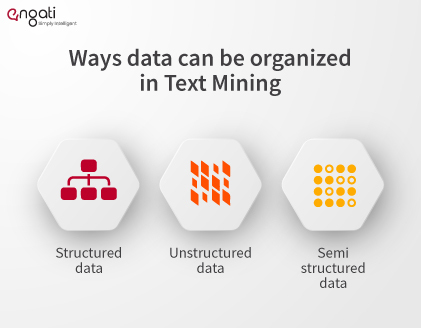
This data is standardized into a tabular format with numerous rows and columns, making it easier to store and process for analysis and machine learning algorithms. Structured data can include inputs such as names, addresses, and phone numbers.
This data does not have a predefined data format. It can include text from sources, like social media or product reviews, or rich media formats like video and audio files.
As the name suggests, this data is a blend of structured and unstructured data formats. While it has some organization, it doesn’t have enough structure to meet the requirements of a relational database. Examples of semi-structured data include XML, JSON and HTML files.
Text mining and text analysis are often used as synonyms. Text analytics, however, is a slightly different concept.
So, what’s the difference between text mining and text analytics?
In short, they both intend to solve the same problem (automatically analyzing raw text data) by using different techniques. Text mining identifies relevant information within a text and therefore, provides qualitative results. Text analytics, however, focuses on finding patterns and trends across large sets of data, resulting in more quantitative results. Text analytics is usually used to create graphs, tables and other sorts of visual reports.
Text mining combines notions of statistics, linguistics, and machine learning to create models that learn from training data and can predict results on new information based on their previous experience.
Text analytics, on the other hand, uses results from analyses performed by text mining models, to create graphs and all kinds of data visualizations.
Choosing the right approach depends on what type of information is available. In most cases, both approaches are combined for each analysis, leading to more compelling results.
Let us now look at the most famous techniques used in text mining techniques:
This is the most famous text mining technique. Information exchange refers to the process of extracting meaningful information from vast chunks of textual data. This text mining technique focuses on identifying the extraction of entities, attributes, and their relationships from semi-structured or unstructured texts. Whatever information is extracted is then stored in a database for future access and retrieval. The efficacy and relevancy of the outcomes are checked and evaluated using precision and recall processes.
Information Retrieval (IR) refers to the process of extracting relevant and associated patterns based on a specific set of words or phrases. In this text mining technique, IR systems make use of different algorithms to track and monitor user behaviors and discover relevant data accordingly. Google and Yahoo search engines are the two most renowned IR systems.
This is one of those text mining techniques that is a form of “supervised” learning wherein normal language texts are assigned to a predefined set of topics depending upon their content. Thus, categorization, or rather Natural Language Processing is a process of gathering text documents and processing and analyzing them to uncover the right topics or indexes for each document. The co-referencing method is commonly used as a part of NLP to extract relevant synonyms and abbreviations from textual data. Today, NLP has become an automated process used in a host of contexts ranging from personalized commercials delivery to spam filtering and categorizing web pages under hierarchical definitions, and much more.
Clustering is one of the most crucial text mining techniques. It seeks to identify intrinsic structures in textual information and organize them into relevant subgroups or ‘clusters’ for further analysis. A significant challenge in the clustering process is to form meaningful clusters from the unlabeled textual data without having any prior information on them. Cluster analysis is a standard text mining tool that assists in data distribution or acts as a pre-processing step for other text mining algorithms running on detected clusters.
Text summarisation refers to the process of automatically generating a compressed version of a specific text that holds valuable information for the end-user. The aim of this text mining technique is to browse through multiple text sources to craft summaries of texts containing a considerable proportion of information in a concise format, keeping the overall meaning and intent of the original documents essentially the same. Text summarisation integrates and combines the various methods that employ text categorization like decision trees, neural networks, regression models, and swarm intelligence.
Text analytics software has impacted the way that many industries work, allowing them to improve product user experiences as well as make faster and better business decisions. Some use cases include:
There are various ways in which we solicit customer feedback from our users. When combined with text analytics tools, feedback systems, such as chatbots, customer surveys, NPS, online reviews, support tickets, and social media profiles, enabling companies to improve their customer experience with speed.
Text mining and sentiment analysis can provide a mechanism for companies to prioritize key pain points for their customers, allowing businesses to respond to urgent issues in real-time and increase customer satisfaction.
Text mining also has applications in risk management, where it can provide insights around industry trends and financial markets by monitoring shifts in sentiment and by extracting information from analyst reports and whitepapers.
This is particularly valuable to banking institutions as this data provides more confidence when considering business investments across various sectors.
Text mining provides a rich and complete picture of the operation and functionality of products and machinery. Over time, text mining automates decision-making by revealing patterns that correlate with problems and preventive and reactive maintenance procedures. Text analytics helps maintenance professionals unearth the root cause of challenges and failures faster.
Text mining techniques have been increasingly valuable to researchers in the biomedical field, particularly for clustering information. Manual investigation of medical research can be costly and time-consuming; text mining provides an automation method for extracting valuable information from medical literature.
Spam frequently serves as an entry point for hackers to infect computer systems with malware. Text mining can provide a method to filter and exclude these e-mails from inboxes, improving the overall user experience and minimizing the risk of cyber-attacks to end users.
Tech Corner
Based on this successful architecture for NLP, language models such as BERT have achieved state-of-the-art results in various NLP tasks. Check this now
Drive to Reimagine
We've evolved from using rules-based chatbots to exploring more sophisticated chatbots because of data, AI, and NLP. Explore the history and uses in this blog.

Tech Corner
Data is currently scattered in most enterprises. Data scientists & developers are working on a common framework. Read on to learn how chatbots are helping!