Drive to Reimagine
8 ways chatbots in banking can improve customer engagement
HDFC, TMNF & 100 others have deployed banking chatbots that give customers financial advice on how to invest, provide info on nearest ATM, account balance
Image processing involves carrying out certain operations on an image to enhance that image or to exact some valuable insights or information from it. It is a kind of signal processing where the input is an image and the output is either an image or the characteristics or features associated with that image. Image processing is now a core research area in engineering and computer science disciplines.
The basic steps involved in image processing are:
The two types of methods that are used for image processing are analog image processing and digital image processing. Analog image processing could be used to process hard copies like printouts and photographs. Here, image analysts employ several fundamentals of interpretation while making use of these visual techniques.
Digital image processing techniques are used to manipulate digital images with the use of computers. There are three general phases that any type of data has to go through while undergoing digital processing. These are:
Digital image processing essentially involves processing digital images on a computer by making use of an algorithm. It is a subcategory of digital signal processing and has many advantages over analog image processing. It makes it possible to apply a far wider range of algorithms to the input data and prevent problems like the build-up of noise and distortion in processing. Because images are defined in two or more dimensions, digital image processing can be modeled in the form of a multidimensional system.
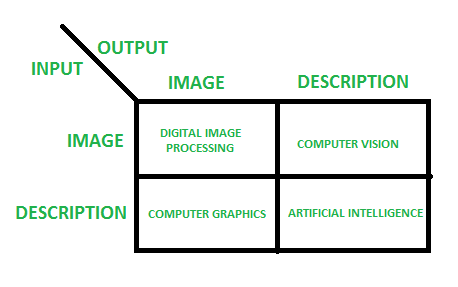
The main objective of image processing is to transform an image into digital form and perform certain operations on it in order to obtain specific models or to extract useful information from the image.
Some of the common purposes for which image processing is used are:
Image processing is generally considered to be arbitrarily manipulating images for the sake of aesthetics or to support a preferred reality. But, a more accurate way to look at it would be to call it a way to translate between the human visual system and digital imaging devices since the human visual system does not perceive the world in the way digital detectors do. The digital detectors impose additional noise and bandwidth restrictions.
Image processing is required to be carried out in a scientific manner so that other people can replicate and validate your results.
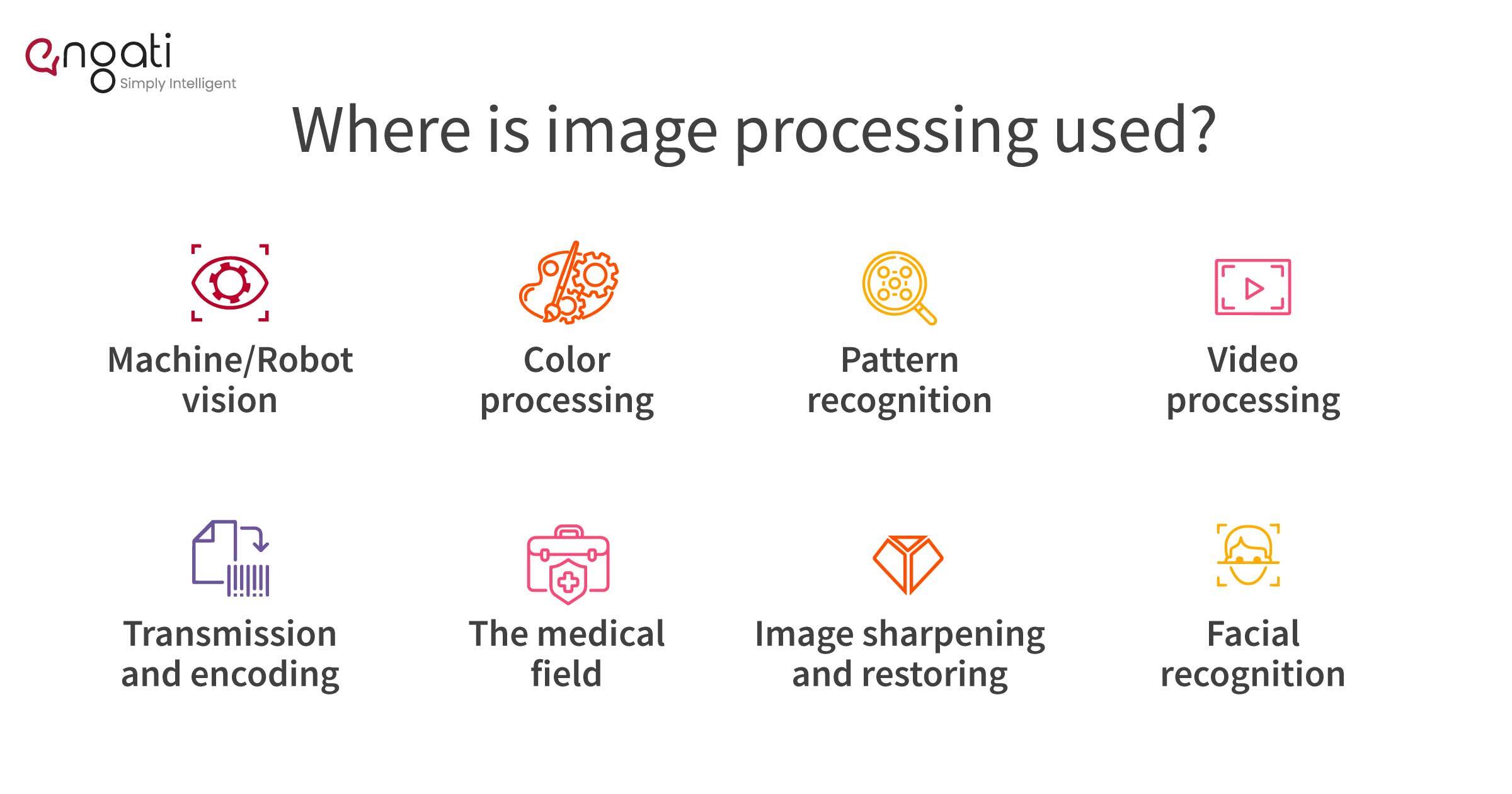
Image processing is widely used in many domains. Here are some of the applications of image processing:
This involves making it possible for machines to see things, identify them, perform hurdle detection (which involves identifying various types of objects in the image and then calculating the distance between robot and hurdles), etc. This has been a lot of progress in this field and the entire field of computer vision was introduced to work on it.
Color processing refers to the processing of color images and the different color spaces that are utilized. It also includes studying the transmission, storage, and encoding of these color images.
Pattern recognition uses image processing techniques to identify the objects in an image and then uses machine learning to train the system for changes in patterns. It is used for computer-aided diagnosis, handwriting recognition, etc.
A video is essentially made up of pictures that are moving at a very rapid pace. Video processing includes noise reduction, detail enhancement, motion detection, frame rate conversion, aspect ratio conversion, color space conversion, e.t.c.
The first image ever transmitted over wire took 3 hours to reach from London to New York. And that picture was black and white, contained lots of noise, and had very low quality. Compare that with today where you can actually have real-time video calls in high quality across continents.
There have been tremendous improvements in transmission over the years. But it is not just limited to transmission. There also been lots of progress made in the field of encoding. Several formats have been developed for high or low bandwidth for the purpose of encoding images and then streaming them over the internet.
Digital image processing (DIP) has multiple applications in the medical domain. Some of these applications include:
This involves processing images that have been captured on a camera to enhance the image or to manipulate them in a manner to achieve a better result. This could involve zooming, blurring, sharpening, grayscale to color conversion, detecting edges, image retrieval, and image recognition.
Facial recognition is a major application of image processing. The machine is initially taught the specific features of human faces. It learns descriptive features, like the distance between the two eyes, the shape of the average human face, which are used as metrics to form the face shape.
The machine then accepts all objects in the image that bear resemblance to the same shape as the face.
Here is a list of some widely used digital image processing techniques:

Drive to Reimagine
HDFC, TMNF & 100 others have deployed banking chatbots that give customers financial advice on how to invest, provide info on nearest ATM, account balance
Drive to Reimagine
To reap all the benefits of chatbot technology and implement it properly, you first need to understand their potential, the advantages and their limits.
Drive to Reimagine
Chatbot trends for 2023 are out and we've listed down the top 10 chatbot trends that will help you grow your business like never before! Read more here!